2026 Spring Homeland | The Backyard Florist
Abigayle Warm Follow
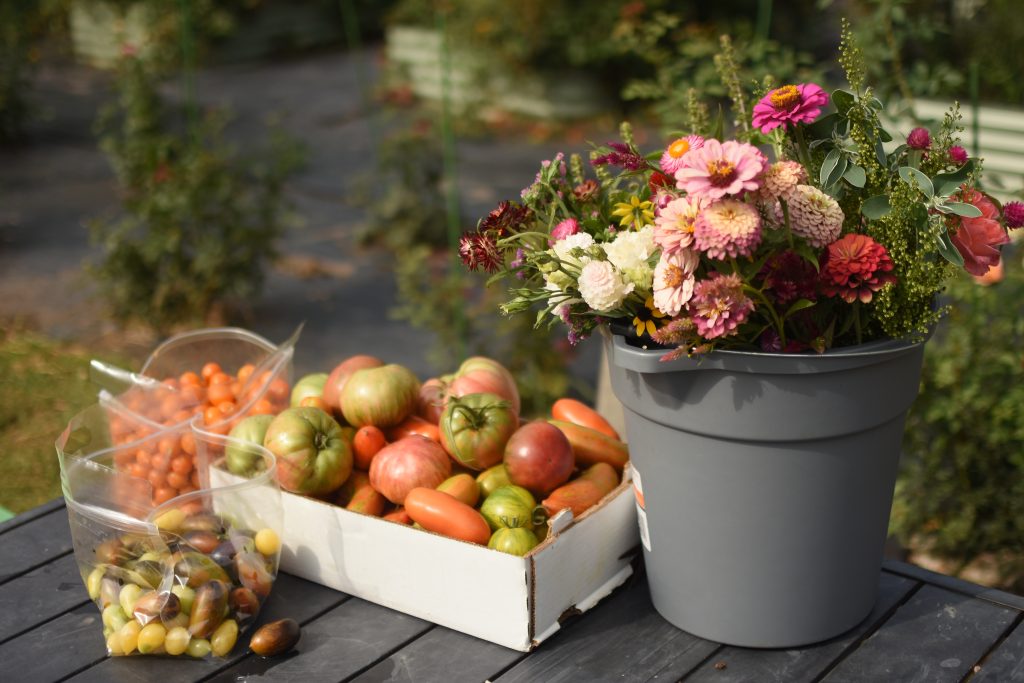
What began as a spring endeavor tending a handful of plants has flourished into an abundant garden and small business in the backyard of Katie Larson’s small-town Nebraska home.
The garden started as a creative outlet and a way to spend more time outdoors with her children, but as the seasons passed, what started as a modest project unfolded into much more. Today, her garden consists of ten 4 foot by 8 foot beds and a greenhouse across a total of 400 square feet of plant-able space.
“The garden is both a teacher and a call to prayer,” said Larson, “a pursuit that is a witness to beauty’s patience, the liturgy of ordinary days, and the quiet mercy found in tending to living things.”
Seed Starting
Now that Larson is a few years into gardening, it is no longer just an early spring and summer activity, but a project that begins in November and December for certain seed varieties that require more time and tending to sprout. Plants like Lisianthus and Eucalyptus require a fall seeding in cool soil since they take roughly 120 –150 days to mature. During this time Larson has planted soil blocks placed on old cafeteria trays in the ”storeroom” of her house, a room she notes that rotates to different rooms around the house based on the number of seedlings she’s starting. She finds the roots get very happy in this setting and “put on a wig” even before seeing the spring sun in the greenhouse.
These micro soil blocks are Larson’s favorite medium for starting her seedlings. Soil blocks take up minimal space and are optimal for the slow stages that happen in the early months of the seed’s growth.
”I can start way more then I’d need this way because the soil blocks don’t take up much space,” said Larson, “And with kids helping, you always have to account for fewer seedlings surviving.”
The soil gets compacted into its own self-standing block, which will eventually get transplanted directly into the ground without any waste. Some gardeners will use compost-based potting mix for their blocks, but Larson keeps it simple with a basic compacted soil matter mix.
When March and April roll around, attention turns to hardening off seedlings in preparation for the greenhouse and eventual transplant outdoors. ”Hardening is a necessary step to increase your rate of seedling vitality and surviving the elements,” said Larson.
This process can vary based on weather at the given time, but generally it takes around three days. If it’s on the sunnier side, she begins with a few hours outdoors and gradually increases exposure — four hours, then six, then eight — avoiding the harsh, high midday sun in favor of morning or late afternoon light. If conditions are overcast, Larson can get away with leaving them out longer and they are ready for the greenhouse after day two.
Wind is another element to consider before transplanting outside into the ground. Larson’s method is to run her hand over the stem a few times each day when watering or checking her sprouts to assimilate wind.
When the plants start showing signs of needing more leg room, the soil blocks get planted directly into the ground.
“Prepare for failure, knowing it’s not all going to work out, but it’s still going to be beautiful,” said Larson, “June is always going to come, and it will always be beautiful despite the flops.”
Anecdotes for the Aspiring Gardener
“Don’t set out to be a full-fledged homesteader day one,” said Larson, “This is how many people get discouraged.” The goal, though noble, shouldn’t be to completely replace the grocery store, but to start by growing what you and your family will truly appreciate and use.
“Putting your energy into what you enjoy growing makes it all more fulfilling,” said Larson.
Another recommendation when starting out is to invest in good stuff rather than going for the ”Home Depot deals.” Larson recounts buying a PVC pipe green house that the wind took out effortlessly and getting a bargain steal on tools and materials that she ended up replacing the next year with things she could have invested in initially.
Lastly, consider your specific climate when it comes to your garden calendar. Larson learned that lesson firsthand after moving to Nebraska from Missouri. Though only three hours northwest of her Missouri home, the climate shift — particularly the wind — forced her to adjust her entire approach.
“I killed almost everything that first year,” she admitted. “Even though I was geographically pretty close, there were many subtle differences.”
Your garden will have a slightly different timeline of planting and when plants start to sprout or bloom. “My gardening friends elsewhere may have flowers blooming weeks before me some years or after in others, and I’ve just come to accept it rather than question and stress over it.” Larson encourages talking to people locally who are successfully growing things because they have adapted to the unique elements and soil types in your area.
Growing beyond the Garden
Building a business wasn’t something Larson intended to do or in any way set out to accomplish but naturally came about as both she and her husband found seasonal pursuits.
“For me, that came from gardening for my husband it was hunting,” said Larson, “Flower & Field grew from the both of us, in two different ways of honoring the land we’ve been given.”
It began simply with making flower crowns for her daughters’ birthdays and experimenting with dried and live floral arrangements. Another branch of the business sprouted from a practical need when one of her children struggled with diaper rash. Larson began experimenting with natural remedies using ingredients she had on hand. “I think it was something simple like coconut oil and shea butter,” Larson said. “But it was the only thing that truly worked on sensitive skin and didn’t have the price tag that high-quality clean products have.”
This endeavor started Larson on the path to experiment with tallow rendering that gradually developed into a line of infused tallow products for skin care and salve she offers in her Etsy shop: FLOWERnFIELD.
“My husband is an avid deer hunter, and he caught a fat doe one year,” said Larson, “I decided to save the fat and render it into venison tallow, and infused it with herbs to make salves. That quickly spiraled into how many of these herbs can I grow myself.”
Larson transitioned to using beef tallow because of greater availability and dove into researching and refining her infusion methods and what plants to use to maximize benefits while minimizing the beefy scent, without using essential oils if she could. Calendula is one of her favorites as it is a heavy hitter when it comes to potency and yet very gentle.
“It’s been really cool to learn how potent some of these plants are that may essentially be growing in your backyard,” said Larson.
Larson carefully chose which plants to infuse the rendered tallow based on benefits and potency, with her little ones in mind. ”With little hands around everything inevitably ends up in their mouth, and because of that, I really wanted to make sure everything I used would be perfectly safe from toddler to newborn,” said Larson. The quality of her products improved, and she wanted to share it with people who would truly value it. This allowed her to keep creating without too many jars stacking up.
“Creation, I’ve learned, is not about control. It is about saying yes to what is given and allowing it to become what it will. The garden remains the truest teacher. Nothing can be forced, and nothing lasts – yet everything is offered, again and again. I steward what’s in front of me. I gather it in its time, make something small, and let it go.”