Catching History book marks 90th anniversary of NWSS Catch a Calf program

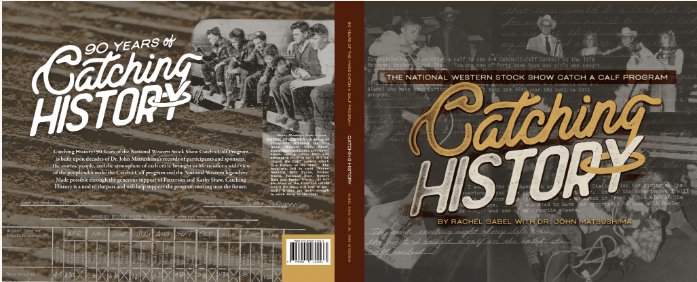
The Catch a Calf program is marking 90 years at the 2026 National Western Stock Show, one of the longest running programs at the event. Since its inaugural year, the program has included nearly 4,000 kids, hundreds of sponsors, hundreds of buyers, and tens of thousands of letters sent to sponsors as updates on the calves and the participant.
Dr. John Matsushima, a long-time sponsor of the CAC program, and his daughter, Nancy Oliver, have maintained records of the participants, sponsors, buyers and winners. Using that information, The Fence Post magazine’s Rachel Gabel researched and compiled the stories of the program in Catching History: 90 years of the National Western Stock Show Catch a Calf Program. The book was designed by former The Fence Post magazine staffer Liz Banman Munsterteiger and includes hundreds of historic newspaper clippings and photos.
The project was generously funded by the Shaws, and book sales will benefit the CAC program for the next 90 years. The 200-page book includes every participant over the past 90 years and many of their stories by decade.
FROM 1950
Richard Reinick, 17, as was reported in the Rocky Mountain News, was one of 10 boys to catch a calf in 1951. According to the article, two stockmen volunteered to give Reinick a calf, but he declined and “showed them he could get one just as well as his two-armed competitors.”
According to the news coverage, the crowds nearly screamed themselves hoarse cheering for Reinick, who struggled with his calf for 12 minutes, dropped the halter and was drug 30 feet from it before backing the calf back to the halter, picking it up with his feet, and slipping it on the calf upside down. He righted the halter with one hand and his teeth before leading it.
Reinick, who lost his arm to a corn grinder when he was 3 years old, joined 4-H and raised turkeys, selling them and raising enough money to purchase sheep. He sold the sheep to purchase a steer, and he sold that steer after successfully showing him at the National Western in 1948. He was first eligible to catch a calf in 1949 but wasn’t successful. After he caught his steer in 1951, Reinick was contacted by Harry Huffman, a businessman and former Denver theater manager, who read about his crowd-pleasing catch.
“I thought to myself, that’s the kind of boy we’re trying to build in America!” Huffman said. “That’s the spirit that can’t be licked!”
Huffman offered to buy Reinick — who was the president of his 4-H club, a trumpet player in the band, and who played baseball, track, and basketball as well as being named to the all-state football team — a prosthetic limb. Reinick declined, telling Huffman there was something he wanted more than a prosthetic arm: a hog. Huffman provided a hog to Reinick.
Reinick returned to the National Western in 1952 and placed 10th with his steer, sponsored by Bill Votaw, a member of the National Western Stock Show committee.
Reinick farmed in the Kersey, Colo., area most of his remaining days, raising hogs, sheep and dairy cows. When he died in 2016 at the age of 82, his obituary made mention of the Catch a Calf program and how he had “caught a catch-it-calf down at the Denver stock show.”
HAPPIEST TIMES
Marvin Maul, Kiowa, Colo., said some of his happiest times were during his years in 4-H. He said each year he and his brothers would show calves at the Elbert County Fair, and if they placed well enough there, they frequently entered them in the National Western Stock Show in Denver.
“My very first calf was what is called a “freemartin heifer” that had been born a twin to a bull calf,” he said. “Because of this, in cattle at least, she was genetically sterile and thereupon could be included within steer judging classes. I’ll never forget the look on the face of the ring steward at the National Western, when he told me where to lead my ‘steer’. When I told him she was not a steer but instead a freemartin, his expression was that I was very dumb or at least some smart aleck.”
According to the rules, entries included “steers, spayed or freemartin heifers,” though she didn’t place well.
He said at the National Western, the catch a calf contest was a highlight for the 4-H boys and was part of the featured events during the evening performance of the rodeo and horse show.
“I entered the event three times but caught only one calf,” he said. “It was a good one though, from the Allard herd in Walden, Colo., and I showed him to the championship at the Elbert County Fair, held that year for the first (and last) time in Simla. Since I was required to show my calf (named Charlie after the president of the John Clay Commission Co., Charles Smith), we placed seventh in the 1950 NWSS Denver competition, probably the ‘high water mark’ in my 4-H club activities.”
Looking back, he said it’s notable that others there for the contest that evening were “none other than Kenny Monfort and John Matsushima.”
FROM 1960
Steve Cummings, Castle Rock, Colo., showed a calf raised by the Wyoming Hereford Ranch and he was sponsored by the South Denver Kiwanis Club. The club met in south Denver and he attended several meetings. He said he was wrestling at 112-pounds the year he caught when he was a junior in high school at 17 years old, though he applied for three years before he had the opportunity. Two of his high school classmates, Jay Godley and Gary Peterson (who is also a veterinarian and attended Colorado State University’s vet school with Cummings) also caught that year.
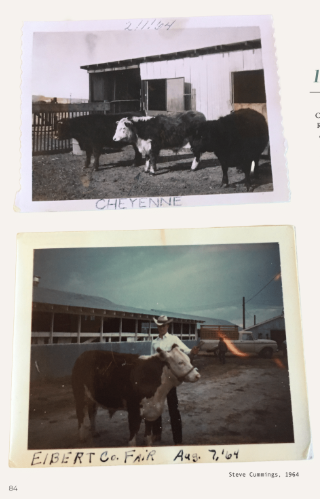
When he returned to show his calf, he said he did fair in class, fetching $467 in a sale to John Clay and Company. He said he also fed a Shorthorn steer with the Hereford and each year Charley Kirk and a few others sifted the calves before the sale and the Shorthorn was sifted and sent to The Yards.
Charley Kirk was the Douglas County agent at the time when Cummings was in 4-H and Cummings said Kirk went on all the club tours, ran the judging program, and ran all the dances.
“There were lots of square dances,” he said. “And you danced. Charley would grab you and put you out there and you danced.”
In retrospect, Cummings said it was likely to wear the kids out prior to curfew to minimize the energy left over being used for nonsense.
Kirk also ran a 4-H camp in Deckers for a week, and several hundred kids would go at a time and he said Kirk ran that camp with the same structure he ran all 4-H activities with.
“You didn’t eat with your elbows on the table,” Cummings said.
There was a creek running through the camp, and though daytime activities occurred on both sides of the bank, the girls bunked on one side and the boys on the other.
“There was a dance every night and he danced your wheels off until about 11, when it was time for curfew,” he said. “He knew that would keep you on the correct side of the creek.”
Cummings said Kirk had made his living in the cattle and sheep business before he came to extension and he epitomized the saying about being “smarter than a bus load of county agents.”
“He could answer about anything about anything,” he said.
Cummings and his wife, Linda, haven’t missed a National Western, save for the year it was postponed due to COVID.
“My parents had a Hereford and Shorthorn business and ran a 15-head show string when I was in a baby buggy in the corner,” he said.
VET CAREER
He said his family’s ranch was sold before he was old enough to take over, which was a blessing in disguise. Never thinking he would own a ranch, he built his veterinary career on an interest and talent for equine surgery.
After veterinary school, he practiced in Franktown and in Douglas County for the better part of 20 years. He sold his practice when it outgrew him, he said.
“I knew another way to make a living and then if I was working at midnight, it was because I thought it was necessary not because someone else did,” he said.
The family moved their cows to a ranch north of Lusk, Wyo., in 1991. They sold the ranch on Boner Road in 2012 and moved to Sheridan where they now run yearlings.
Cummings’ 77th year attending the National Western was just before he turned 78 years old.
FROM 1970
Keith Kautz, Huntley, Wyo., grew up on farms in Wyoming and Nebraska and earned a degree from the University of Wyoming in 1975 and his law degree in 1978 from UW. He was in private practice from 1978 to 1993 in Torrington, Wyo., before he was appointed a state judge serving on the Wyoming District Courts, serving Converse, Goshen, Niobrara and Platte counties. In 2015, he was sworn in as a justice of the Wyoming Supreme Court before retiring from the bench in 2024. In July of 2025 he returned to the active practice of law, and Gov. Mark Gordon appointed him attorney general for the State of Wyoming.
FROM 1990
Molly Waneka Keil watched her dad, Bill Waneka, who caught a calf in 1967, for a number of years helping with the program and when she was of age, there were more applicants than calves, so there were 16 drawn per rodeo performance vying for eight calves. It was disappointing not to be drawn, but she still watched with great interest. Her grandfather, Chuck, was a longtime sponsor of Catch a Calf and a fixture at the National Western.
“One evening, a kid didn’t show up, and I was able to jump in and catch that year,” she said. “Ms. Sue Anschutz Rodgers was my sponsor and at that age, I didn’t realize who she was I just knew she was a beautiful woman who sponsored me.”
In 1997, when she returned to the National Western, she won first in class with her steer. That success was something she said, she certainly wasn’t expecting.
The most prevalent aspect for Keil as a participant was going off to college at CSU and realizing the number of connections she had made.
“Walking into the cafeteria and spotting someone from the West Slope my dad had sponsored was eye opening,” she said. “Through those relationships, your world became smaller. That has carried on into adulthood and the connections I made have only grown. I was at a wrestling tournament not too long ago, and there were six families I knew.”
She earned a degree in ag Extension and education, and was an extension agent in Albany County, Wyo., and that’s when she became involved in the Catch a Calf program as an adult volunteer. Keil was the superintendent of CAC 2006 through 2021.
While she was an Extension agent, she sponsored participants from Albany County and one of them, Kinsley Gallegos, lives nearby and has, in turn, become a mentor to Keil’s children.
She recalls another girl who she noticed practicing in the ring at the National Western. Her parents, Keil noticed, were ringside watching and were in tears. She learned that the girl’s father had been injured and had spent most of the year in a military hospital and her mom had been with him. The work of the calf was completed almost entirely by the young lady and that calf, Keil said, had become the girl’s salvation.
Keil said her dad loved to tease the kids on deck to catch calves. Holding a giant syringe filled with Mountain Dew, he would tell them the calves needed to be safe from whatever the kids might have and he would tell them to line up. Most parents realized they were joking, thankfully, and the little ones would quietly work their way to the back of the line. One evening, though, she said one brave girl stepped right to the front, looked Waneka in the eye, and readied for the “shot.”
She recalled another young man she said struggled to pay attention in meetings and found the letter writing and communication with sponsors to be challenging. She said she later learned the boy had autism. His mother told Keil she never wanted autism to be an excuse for him and get in the way of the calf, which she said was the first thing he was truly responsible for.
“It’s never really about the calf,” Keil said. “In the moment, it’s about the animal and the records, but in the end it’s about the connections and experiences.”
From the sponsors: Mike and Eva Pugh/County Line Cattle Company first sponsored in 1998 and have sponsored 22 participants over 22 years. Mike and Eva began sponsoring after their nephew Ryan participated in the late 1990s.
Eve said a young woman pushing a stroller said hello at the Elbert County Fair and introduced herself as their former Catch a Calf participant. She was there with her older child who was exhibiting livestock, something she proudly credited the Pughs with encouraging and establishing.
Two years ago, they were visiting “their kid” at the Wyoming State Fair and another past participant, Kellie Hinman (2002-03) stopped them to tell them she is now working in Extension.
“Those are the ones that mean so much to us,” she said.
The Binning siblings — three sisters — from McDonald, Kan., (Porsha, 2016-17, Bianca 2018-19, and Jazzmin 2019-20) were all sponsored by the couple. Never one to pass up a road trip, Eve said they tend to choose out-of-state participants to sponsor because they’re so able to travel to go see them. They made several trips to Kansas, even attending a school play and a cheerleading competition to support the girls in all their interests.
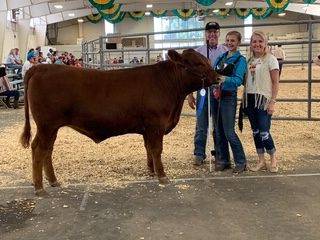
“Eve and I get the gratification of helping these kids and we get to meet their families as well and we enjoy getting to know them as well,” he said. “It’s great seeing these kids after a number of years and see them doing well.”
Mike said they’ve seen what the program can do to enhance the lives of kids, but they value the relationships they’ve built with other sponsors and other members of the Catch a Calf committee.
Over the years, they’ve had several wins either grand or reserve and earn a spot in the Junior Market Livestock Show and they said that’s particularly exciting.
“Having seen the letters over the month and hearing the ups and downs, it’s really exciting,” he said.
Pat and Kathy Shaw/Savant Resources, LLC, Shaw Resources, LLC have sponsored 20 participants in 20 years, beginning in 2006. Pat Shaw, Erie, Colo., always wanted to have cattle and showed them through his 10-year 4-H career. In 1975, he was one of the participants in the Catch a Calf program who caught and returned the following year.
Rooted in western Kansas and Colorado’s Front Range, Patterson (Pat) Shaw and his wife Kathleen (Kathy) have dedicated much of their lives to youth education, agriculture and the western way of life. They raised their children, P.J. and Elena, in Denver while also spending time at their historic Company Ranch in Grand County, originally founded in 1908 by Gov. Elias M. Ammons, Colorado’s 19th governor and the first president of the Western Stock Show Association. For more than 30 years, the Shaw family has proudly supported the National Western Stock Show as Catch a Calf sponsors and Catch a Calf committee member for over 20 years, Coors Western Art, the Auction of Junior Livestock Champions, and the National Western Scholarship Trust on which Pat served as Trustee from 2019-2024. Pat is a member of the Legacy Capital Campaign Committee and Chairs the Livestock Campaign Committee as well.
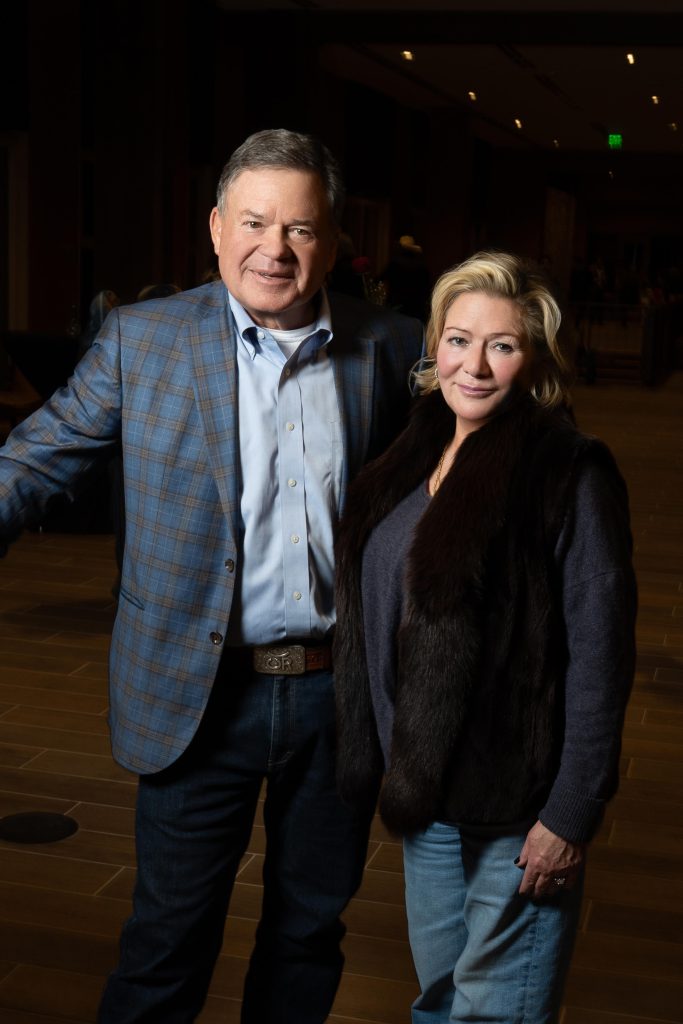
“The Catch a Calf Program is designed to give participants hands-on experience in raising and managing a market beef animal including essential skills of animal health, feeding, budgeting, recordkeeping, and marketing, It’s the longest running educational program at National Western and in 2026 will be celebrating its 90th year.”
Pat grew up in the small town of Erie and was a member of the Idaho Creek 4-H Club. Kathy and Pat first met at the Boulder County Fair. He was showing steers and Kathy was selling buttered corn at the Longmont High School cheerleader booth. After high school they both attended CU Boulder, graduating in 1982, Pat in business and Kathy in journalism. While still in college, Pat got started in the oil and gas business in 1981 as a landman acquiring oil and gas leases in the DJ Basin. Before starting their family in 1991, Kathy was public relations director for Colorado Ski County USA. “I got into the oil and gas business because I admired so many of the farmers and ranchers I had grown up around, and I thought being a landman was one of the ways I could do business with all those good people.” In 1988, he started his first independent oil and gas company and has since drilled wells throughout the Rocky Mountain region, as far south as Texas, east to Kentucky, west to California and north to Alaska.
“I’ve been lucky, and I’ve worked with some amazing talented people in my career. I came from a long line of coal miners and sometimes I can’t believe how things turned out. Many of the skills I use in business first came from being in the Catch a Calf program, leadership, communication, writing, recordkeeping, things I’ve used in the oil and gas business every day over the last 40 years.”
Although only growing up on a 20-acre alfalfa farm, Pat always wanted to show cattle which he did in Boulder County for 10 years.
“In 1969, I borrowed money from my Aunt Lois for my first steer and since I made the sale, paid her back the next year. I loved the fair. My brother and I always thought it was better than Christmas. I had some success in what was a competitive (Boulder) County Fair, but never competed with families like the Andersons, Smiths and Biellas, they were pros. After 10 years in 4-H, I had a ton of fun and great memories, learned many life lessons and even had nice savings account for college.”
With the encouragement of Chuck and Bill Waneka, in 1974 Pat signed up to try Catch a Calf at National Western. As Pat recalled, “when I was in my first Catch a Calf contest I was out maneuvered by some bigger and wiser participants, man was that disappointing.” Not to be discouraged, he signed up again the following year.
“My next attempt was in 1975 resulting in a “catch.” I can’t tell you how proud I was that evening as I led my steer off the coliseum floor. I diligently threw myself into the contest, paying full attention to my steer, recordkeeping and corresponding with my sponsor, Mr. Jerry Scarboro with Commercial Banks and the State of Colorado Bankers Association. I don’t remember how I placed overall, but I do remember I was second in record books.” Pat added: “I couldn’t afford to buy expensive club calves, Catch a Calf gave me the opportunity to show at the National Western, which I wouldn’t have been able to do otherwise.”
The following year, he had a champion Hereford heifer at Boulder County and with the confidence gained in Catch a Calf decided to take her to Denver in January. “She was a solid Hereford heifer, the best I had ever had. There were about 40 entries in my class and as we walked our cattle through the tunnel into the arena, a judge was standing right there. He quickly sorted half the class to the right, the other half to the left. Shortly after he got on the microphone, thanked everyone for being there and promptly dismissed everyone on the left, me included. Wow that was an eye opener about showing in the big leagues. Other than Catch a Calf, my time in the show ring at National Western lasted about 5 minutes.”
As a member of Roundup Riders of the Rockies, in 2017 Pat organized a small group of like-minded riders and others sharing his interest in Catch a Calf. Over the past eight years “Round Up Rider Friends of Catch a Calf” have donated more than $270,000 to purchase the Grand or Reserve Champion Catch a Calf at the Auction of Junior Livestock Champions held the last Friday of NWSS.
“We’ve all bought champion animals at county fairs and stock shows, and that donation goes to that individual young boy or girl, and they deserve it for all the hard work it takes to get there. But what I really like about the Catch a Calf program is the Junior Auction sharing formula. Winning Catch a Calf bids are divided between the two champion exhibitors, the Catch a Calf program and all other Catch a Calf participants that year. Catch a Calf provides young men and women an invaluable education experience and everyone in the program gets a donated calf, the market buyback after the show and a share of the grand and reserve champions auction proceeds. Overall, I don’t think there is a more important or rewarding 4-H or FFA program anywhere else.”
Pat and Kathy’s contributions to the National Western are rooted in their belief in the importance of extending to future generations those lessons and values Catch a Calf so deeply instilled in Pat.
Gabel and Matsushima will be signing copies of Catching History at the National Western at the new Catch a Calf Pavilion in the Sue Anschutz-Rodgers Livestock Center on Friday, Jan. 9 from 3 to 5 p.m.; Saturday, Jan. 10 from 2 to 4 p.m.; and Friday, Jan. 23 from 4:30 to 6:30 p.m. at the National Western Club. Books may be purchased at the CAC Pavilion, at the signings, or ordered online at Rachelgabel.com/store beginning Jan. 5.
HanSine Ranch Bull & Female Sale
HanSine Ranch is gaining the interest of Red Angus breeders across a big region.