Forage 2026 | An Art for Life: Range management
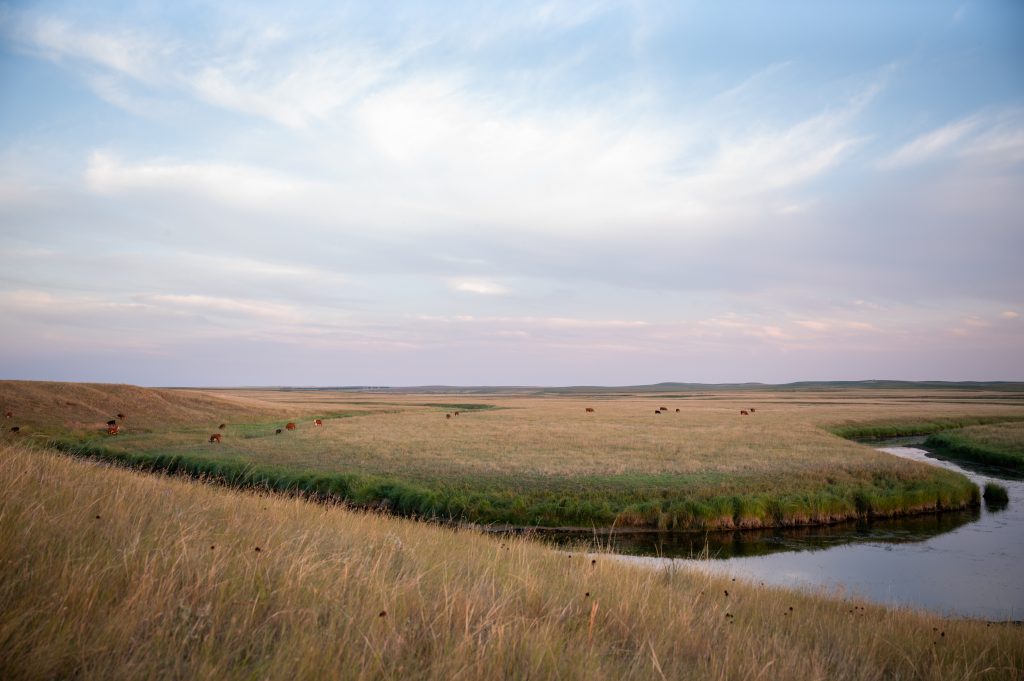
Lauren Weishaar | courtesy photo
Shawn Weishaar developed an interest in range management at a young age, but it was ultimately a range science degree that led him back to the family ranch.
“My uncle, Bill Johson, always had a strong interest in range management and he shared a lot of that with us whenever we would go help out there,” Weishaar said. “He was always pointing out plants when we were going through the pasture. He opened my eyes to different things in the pastures; whenever we went anywhere it was always a learning experience.”
Weishaar enjoyed attending Range Camp in North Dakota, where he grew up, and competed in range judging with the Lemmon, South Dakota, FFA chapter, where he attended high school.
“It was something I really enjoyed and a big part of my life growing up, so it just seemed natural to go into range science in college,” he said.
Shawn and his brother Scott both ranch in western North Dakota, Scott on their grandpa Johnson’s place where their mother grew up, south of Sentinel Butte. Shawn and his wife, Sarah raised their family on the Weishaar home place north of Lemmon, South Dakota.
“We were pretty fortunate that this fell into place for us,” Shawn said. “When my uncle Bill retired, he made it work for Scott to move out there. Scott and I work back and forth, and do everything together we can.”
The two places are distinctly different, and are managed differently, but the ultimate goal of healthy rangelands is the same.
Scott is on the little Missouri River in the badlands, with “pretty much a strictly cow/calf operation,” Shawn said. “There is not lot of hay land and very little farming. If they do any farming it is just for feed.”
While Shawn also primarily has a cow/calf operation, he also does some grain farming.
“We’re more diversified where I live,” he said. “We have a mix of improved pastures with alfalfa and crested, farm ground, and native prairie.”
Firsthand experience with the two ranches has given Shawn an appreciation for their differences.
“While Scott has a lower carrying capacity, he has good natural protection,” Shawn said. “There’s less chance that cattle will drift in a storm. Where I live, when a storm is coming we need to make sure everything is in place or else we’ll have a big mess. We both have good water. They get more drought and hay is always a challenge. For us, hay isn’t usually too big of an issue.”
Scott, like their uncle Bill and grandfather, does not depend on feeding a lot of hay.
“They always got by with some cake and would save some good winter grazing,” Shawn said.
No two places are ever the same, Shawn said.
“In western North and South Dakota there can be a lot of variability within a few miles. There is no ‘one size fits all’ approach to range management. There are a lot of different ways to do things because of where you are located, your resources, soils, rainfall. There can be a tremendous amount of variability. We’d like to think everything is the same but it really isn’t.”
Even with a love for rangelands that began at a young age, Shawn Weishaar went to South Dakota State University unsure of whether or not he wanted to return to the ranch. It was his professors and the coursework that eventually led to his decision to go home to ranch.
“When I went to college I really wasn’t sure I was going to come back home,” he said. “I had some great range professors, and between them and the animal science and business classes, there were some good fundamental ideas given to me when I went to school.”
Weishaar said he appreciates the broad perspective of ranching he was given in college, and values it more as time has passed.
“It was time well spent,” he said. “I had to get away to know I wanted to come back. I don’t think that would have happened, if everything hadn’t fallen into place for me as it did in college.”
Grazing management was a favorite class in college.
“My professor, Dr. Sowell, spent time going over research papers, talking about different grazing systems and the pros and cons with each. He was really good at establishing that there are a lot of different ways of doing things. You first have to know what your resources are, what kind of precipitation to expect, and what you have to work with to establish a sound stocking rate for your operation and develop the flexibility to deal with drought.”
Drought management, business classes, and livestock production gave Weishaar a solid basis for ranch and range management.
Except for his time at college, Weishaar has live his whole life on the same ranch.
“Range science is a degree but it is really an art form,” he said. “Things change from year to year. I’ve seen years where we had a total of four or five inches of rainfall to years where we had over 30 inches. To deal with that much variability is a challenge. Dry cycles are a big challenge, but ‘too much’ rain creates challenges too.”
While adaptive management was not specifically taught in class, Weishaar picked up on it through seeing how a variety of operations were managed.
“We spent a lot of time visiting ranch operations, and some of that was brought through on field trips, visiting with producers or researchers, or even park managers. We even went to coal mines and looked at the reclamation work they were doing. I think it is probably taught a little more now, but I learned through experiences and meeting people who were doing different things.”
Raising a family on the ranch is one of Weishaar’s greatest joys.
“I really value bringing my kids up in ranching, it’s been important for me for them to get go to South Dakota rangeland days and participate in FFA range judging, whether they go into range management as a career or not, I think it’s going to take them a long ways in life. It’s important not to take rangelands for granted as much of the world does. We really have a great story to tell.
“We produce a healthy protein product, provide wildlife habitat, coexist with grazing animals in a relatively natural environment, something often overlooked by a lot of the world. Rangeland constitutes a huge portion of the world’s land use, but doesn’t get the recognition it deserves, it really gets taken for granted.”
Whether or not Weishaar’s children come into ranching, he is glad they can see how amazing rangelands are and have had a part in the ranch.
“I hope they are spokespeople for ranching and our way of life, that’s pretty important,” he said.
Personal choice does factor into management practices, along with resource management, Weishaar said. Some may choose a very intense management plan, while others may opt for a more low-key strategy.
“Everyone is wired a little differently and finding the right balance is a personal choice,” Weishaar said. “With any operation you just can’t overgraze or it will bite you back.”
Weishaars focus on “making the cows work for us” and try to reduce labor and simplify management practices as much as possible.
“We do some rotational grazing, but not real intense like some people do,” he said.
Weishaars rely on introduced grasses such as crested wheatgrass for spring grazing and use some of their cropland to plant cover crops for grazing and annual forage crops for hay production.
“The cow has to work for you,” Weishaar said. “We have to do our best job of taking care of them, but don’t need to do everything for them. As much as I like my cows, I don’t want to spend all of my time with them. We’re trying to reduce labor, reduce costs and still have a good product at the end of the day.”
Navigating markets, weather and everything that comes along with it can be a real challenge. Weishaars have tried to reduce their workload by calving later, doing as much fall and winter grazing as the weather will permit, and doing more with yearlings as part of their drought plan.
“Yearlings can be moved off pretty quickly without reducing the cow herd,” Weishaar said.
Weishaar enjoys learning about different varieties of grass and alfalfa, cover crop grazing, and how to maintain a broad forage base on the ranch.
“Maybe 20 years ago we were more focused on encroachment from things like crested wheatgrass and cheat grass. Now it has switched to Kentucky bluegrass and smooth brome. These seem to be the big problems in a lot of pastures, but you can go 50 miles and find a completely different issue.
“We’re figuring out how the native prairie is very special and we need to keep it diversified,” he said. “For me, it is always great to go out in the spring and see grouse dancing while checking cows. We have a lot of birds coming through in the spring, and a lot of diversity in the birds and wildlife on the ranch. Cattle operations protect that. Not a lot of people realize how important livestock are to protecting wildlife of all kinds, not just the stuff we hunt.”
Introduced plant species are here to stay and are just one factor range managers have to work with, Weishaar said.
“We need to keep the really bad ones, like leafy spurge, Canadian thistle and wormwood at bay, and protect our native prairie,” he said. “We need to do things to keep our plant communities diverse. Kentucky bluegrass has exploded in the area; in a lot of cases we aren’t getting it grazed hard enough early on and pulling off too soon to make a dent in it. It probably needs fire to be brought back as a management tool. There is a place for fire but I don’t know how we would manage the risk. We have had some terrible fires in our area and I don’t like seeing that.”
Sheep and goats can be a valuable option for keeping weedy plants in check on the range. Weishaars sold their sheep recently, but if one of their children returns to the ranch, sheep may come back to the operation.
“Sheep put me through college,” Weishaar said. “We are set up for sheep but never had a large scale sheep operation. We always kept them close to the place because coyotes are an issue.”
Dealing with drought is always an issue when managing rangelands, and one drought-related issue often leads to more problems.
“We can always look for ways to be more drought resistant,” Weishaar said. “We have drought plans in place and try to give ourselves a cushion to minimize problems.”
Weishaar enjoys being his own boss and the variety of work that fills the changing seasons on the ranch.
“Every season brings something new, and every year brings different challenges,” he said.
A long-time member of the Society of Range Management, Weishaar is grateful for the organization’s work at the state level, as well as NRCS and state extension range specialists who work in his area.
“Rangelands are out of sight and out of mind for many people; as with everything in ag, we need to do a better job of educating the public and ourselves,” he said. “The main thing is not to abuse this resource. We need to strive to keep rangeland diverse and protect it.”