Lies agreed upon: Jim Mundorf says beef industry should push back on climate claims

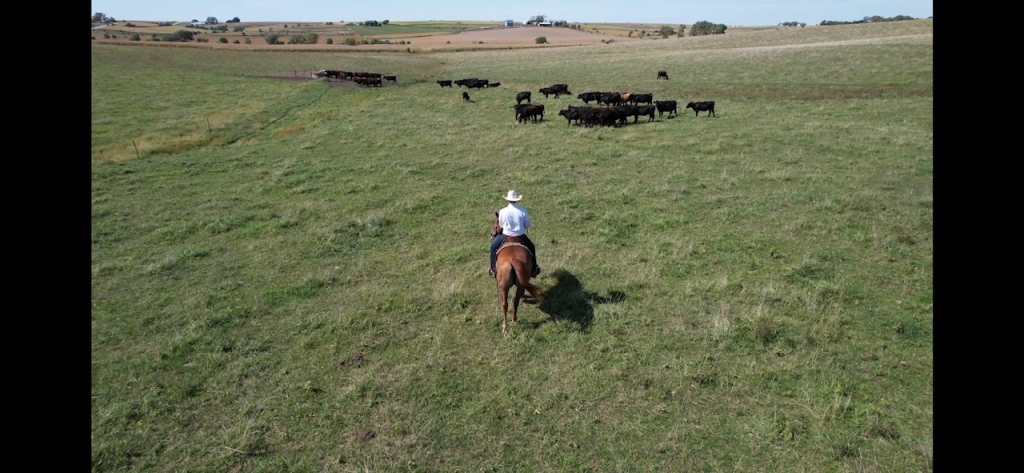
“Lies agreed upon.”
That is Jim Mundorf’s description of the conversation surrounding agriculture’s effect on the climate.
Mundorf, a southwestern Iowa cattle rancher and farmer, said his main source of income is his own business, The Drover House, a unique venture of mounting and creating artwork from the horns of Texas longhorns.
Mundorf has also become known as an outspoken advocate for independent livestock producers, and recently spoke to producers at the Black Hills Stock Show in Rapid City, South Dakota.
“I don’t think it’s being said enough. This whole thing about carbon collection and carbon measurements is based on the lie that agriculture is destroying the climate or the planet. That they are a big contributor to climate change. It’s just not true. But it’s generally accepted by the corporations,” said the “Lonesome Lands” video (vlog) creator.
Mundorf recalls hearing on the radio in 1989 that “the world would be unrecognizable” in 10 years because of global warming.
“The world is not unrecognizable. None of their predictions came true,” he said.
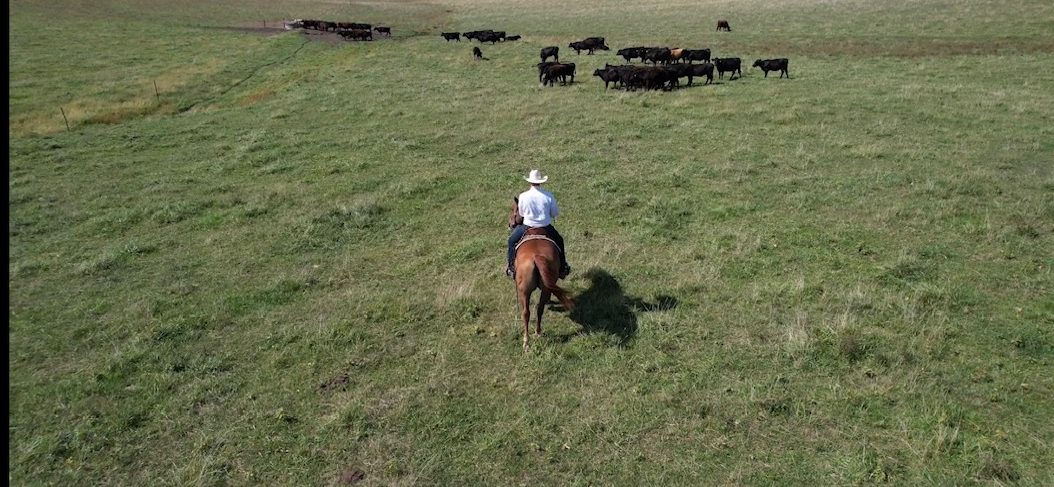
Agriculture’s message should be simple and clear. “We are not destroying the planet,” said Mundorf.
“It’s common sense. These are animals that have been a part of our environment. Cattle have the same stomach as buffalo,” he said. The National Park Service estimates that 30 million to 60 million bison (buffalo) once roamed what is now the United States.
The farmer protests in several European countries including Germany, Ireland, the Netherlands, Belgium, France, as well as our own neighbor to the north, Canada, have shown the farmers’ response to the “net zero” political pressure to reduce carbon output.
On Feb. 6, 2024, Reuters reported that “The European Commission recommended on Tuesday that the EU slash net greenhouse gas emissions by 90 percent by 2040, an ambitious target that will test political appetite for the region’s fight against climate change ahead of EU elections.”
Back in the United States, corporations working behind the scenes to lobby congress have incrementally brought in “climate smart” concepts like “low carbon beef,” “climate smart beef,” etc. “When you accept those terms, you accept the lie that there is high carbon beef,” he said.
Farm Journal, in 2022, was awarded a $40 million USDA grant for its connected ag project related to USDA’s Partnerships for Climate-Smart Commodities.
Just recently Farm Journal announced a partnership with Ducks Unlimited, and ABS Global was added to its list of coalition members which already included Merck Animal Health, National Cattlemen’s Beef Association, Enogen/Syngenta, Tyson Foods and the U.S. Roundtable for Sustainable Beef.
South Dakota State University was provided an $80 million federal grant and a non-federal match of $81 million, which will be used to “create market opportunities for beef and bison producers who utilize climate-smart agriculture grazing and land-management practices,” said SDSU.
SDSU said the $80 million is the largest grant ever received by the university.
Mundorf fears there is an unseen cost to these initiatives and the general push toward “climate smart beef.”
He believes that what is measured can then be controlled, and he believes that if and when the “climate impact” of livestock is quantified, the next step will be for corporations and government officials working in tandem to call for a reduction.
“When you get into profitability of these corporations, their main goal is to placate their shareholders,” he said.
He believes the desire for control is driven in part by a move toward further vertical integration and also by corporations’ desire to comply with ESG (Environmental Social and Governance) standards.
Mundof points out the irony of companies like Tyson Foods, whose stated goal is to achieve net zero greenhouse gas emissions by 2050 (including its “scope 3” suppliers which is the producers of the cattle) who are simultaneously actively working to achieve more vertical integration in the cattle industry, which forces small, local feedlots out of business in favor of huge feedlots.
“Iowa used to be full of 300 head feedlots, now those cattle are being fed in large lots in Texas, Kansas, Nebraska. Tell me how that is more sustainable,” he says.”The entire goal of the climate alarmism and climate crisis message is to control people. I think that has been the goal from the beginning.
“When you look at how corporations control things in Europe, we are on that road,” he said.
“In the Netherlands, to begin with, farmers went along with regulations. They wanted to go along. They compromised to do what the government wanted them to do, and then at the end, as they continued to compromise, they realized they were going to be put out of business and when that happened the government said it would buy their land, or take it and pay them whatever they decided. That’s when the protests started.
“That started with the government’s idea of saving the planet,” he said.
Mandatory animal identification, he says is key to the underlying control.
“It’s the key to regulating small farmers and ranchers’ emissions,” he said.
But what about the argument, if you aren’t at the table, you’re on the menu?
The Beef Checkoff has produced information to defend the US beef industry.
“The U.S. has an emission intensity two to nine times lower than top beef production countries such as Australia, India and Brazil. The U.S. has had the lowest GHG emission intensity in the world since 1996” says the Beef Checkoff on its website.
The Checkoff goes on to add:
The Emissions Intensity of the U.S. Beef Industry is:
- Over 2x lower than Argentina
- About2x lower than Australia
- Nearly 3x lower than Brazil
- Nearly 2x lower than Canada
- About 9x lower than India
The Beef Checkoff has funded other studies in an effort to prove the beef industry’s impact on the environment is not as severe as anti-beef radicals claim.
The National Cattlemen’s Beef Association, a member of the US Roundtable for Sustainable Beef, reports on its website that, as an organization, it is “committed to a pathway of continuous improvement, which protects our natural resources; promotes economic well-being for the beef community; and provides social value for our supply chain, communities and stakeholders.”
On its site, NCBA also shares, “The cattle industry is committed to leading the charge to ensure that farmers and ranchers have the most up-to-date research and technologies related to carbon sequestration and emissions reduction.”
One of NCBA’s goal is: to demonstrate the climate neutrality of U.S. cattle production by 2040, another is: create and enhance opportunities that result in a quantifiable increase in producer profitability and economic sustainability by 2025.
In 2021, NCBA released the following information, when announcing its commitment to climate neutrality by 2040.
“Cattlemen and women have demonstrated their commitment to sustainability for generations. They work tirelessly to protect the land, water and air resources in their care. Through countless improvements in genetics, grazing management, manure handling and the adoption of many other technologies, this is just the next step on our industry’s path,” said Marty Smith, a Florida cattleman and NCBA past president. “Producers deserve recognition for their use of cutting-edge practices and technologies that minimize environmental impact. By setting goals, we’re publicly committing to continuous improvement and setting targets that allow us to measure and document those efforts.”
“Sustainability is, and will continue to be, an incredibly important part of what we do, and I’m proud that my fellow leaders across the cattle industry have taken these important steps,” Smith said. “As our country and the world examine risks associated with climate change and other sustainability challenges, our commitment to sustainability positions us to play an even bigger role in mitigating these risks in the future.”
R-CALF USA President Brett Kenzy, Gregory, South Dakota, said Americans need to be more confident defending the principles that made American successful
He also said that he is realizing that the immense struggle to gain congressional support for seemingly common sense issues like mandatory country of origin labeling, checkoff reform and enforcement of the Packers and Stockyards Act, is more clear when looking at it through the lens of “this is what they’ve (global corporations) been working on all along – controlling agriculture,” he said.
“We were told that through deregulation, consumers would benefit through lower prices. But corporations have a fiduciary responsibility to create a profit, they aren’t benevolent, they don’t exist to benefit the consumer. R-CALF has been fighting for the independent American cattle producer, while DC has been on a completely different trajectory toward globalism,” he said.
“In the end, the ultimate question we have facing us is, does America matter? And if you answer yes, what do we have to do to make our government respect the American citizen again? The ones that make things, grow things, keep the electricity on. That’s what society is built on,” he said.
Kenzy was greatly encouraged to see the Natural Asset Company proposal pulled. The idea proposed by the NYSE is to list companies with missions to improve ecosystems through management, maintenance, or restoration of public or privately-owned lands — and then put a dollar figure on the resulting benefits, like clean air or wildlife habitat, according to Greenwire.
“We pushed back on NAC. We had 20 some state treasurers stand up against it, 25 state AGs, and 30 some house members stand up. That’s heartening. How do we support these people and add to their ranks? That’s how it will have to be done,” he said.