Property Rights Rally: Landowners gather at South Dakota’s capitol building; say ‘no eminent domain’ for carbon pipelines

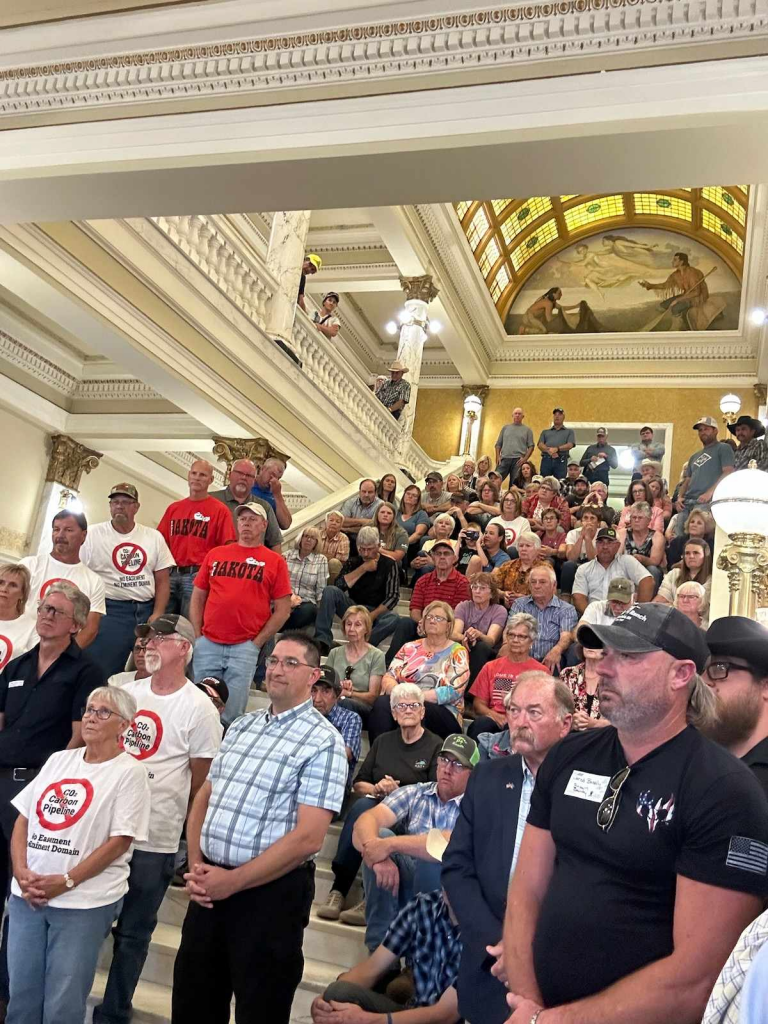
Over 500 people stood for property rights at the South Dakota capitol building July 6, 2023.
The group called on Governor Noem and the South Dakota legislature to call a special session to address help protect property owners from the threat of eminent domain in the face of two carbon capture pipelines hoping to cross the state.
Summit Carbon Solutions and Navigator, two different C02 capture pipelines in the planning stages, both intend to collect C02 from ethanol plants and deliver the waste product to underground disposal sites. The first intends to dispose the C02 near Beulah, North Dakota; the second, in Illinois.
Both pipelines companies are privately-owned, with large corporate investors. The investors provide working capital for the pipeline projects, and tax credits would provide an income stream.
Summit and some legislators who have publicly supported it say that the project will help the ethanol business by potentially giving ethanol plants the ability to sell into markets such as the west coast, where laws may demand that the fuel be produced with a lower “carbon footprint.”
Landowner Jared Bossly of Brown County, South Dakota joined several other landowners to organize the July 6 rally. The Summit pipeline proposes to cross Bossly’s land, near his cattle pens, and through an area he had hoped to someday build calving barns and another calving lot, in order to expand his operation to make room for his kids to ranch with him.
Bossly said the event was powerful.
“I’m used to talking to cows and tractors that don’t work, and maybe a nice looking bale,” said Bossly. It was powerful to be in there. To talk to people. To hear them cheering.”
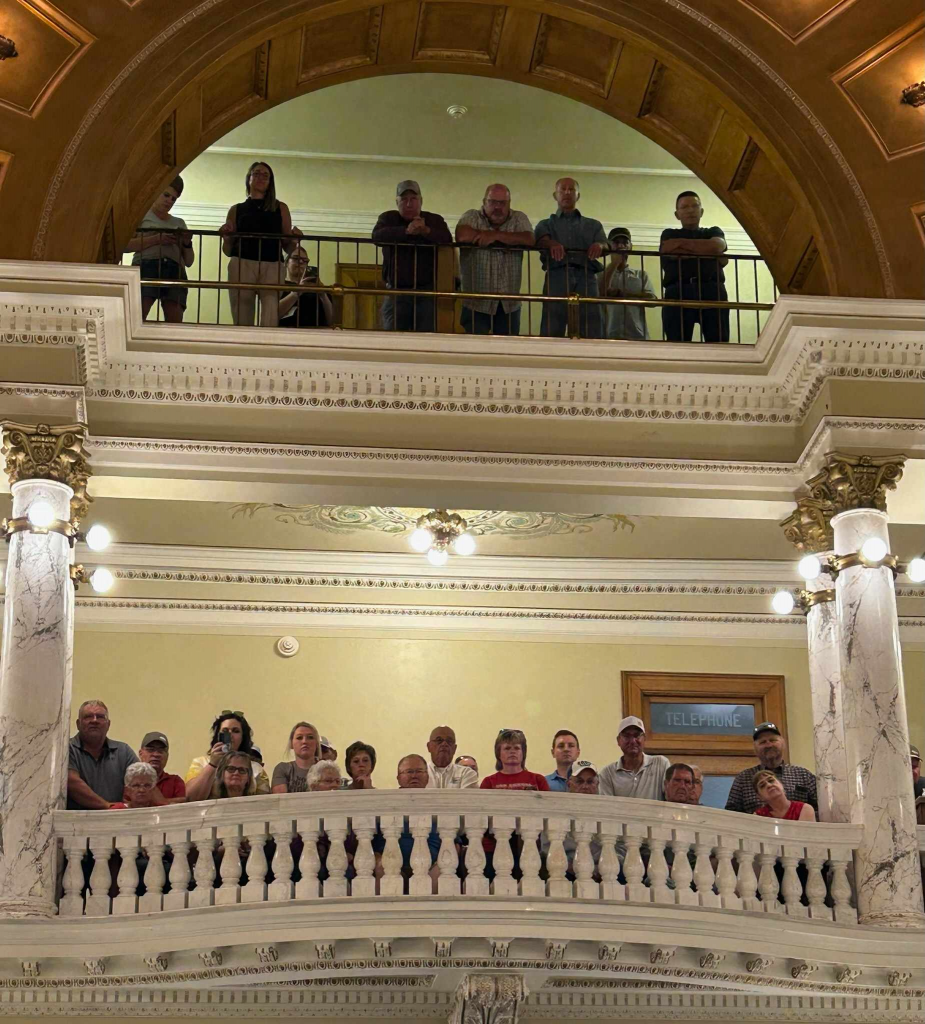
Capital police reported that about 560 people attended.
“The whole rotunda was full, top to bottom,” said Bossly.
Some who attended were not personally affected, but wanted to support property rights, he said.
Summit asked Bossly for a permanent easement on his land for the pipeline, but he declined, as did his neighbors. Summit entered his property without permission to talk to him about surveying. The company then took him to court to get a restraining order against him. Bossly was ordered by the court to remain 100 feet away from Summit when the company surveyed his property. South Dakota law states that surveys are allowed, even without permission from the property owner. The survey included equipment that drove over new tree plantings, killing trees, and a drilling rig which bored 90 feet into the ground on both sides of a slough on his property, said Bossly. The company then dumped the slurry into a ditch.
“They asked if they could dump the slurry in my field and I said no.” Bossly said he noticed after the truck moved to a different field that a barrel of slurry was tipped over in the ditch. “that’s littering. We don’t take scoops of manure or grass clippings or whatever and dump it in the ditch. If we did, we’d get a ticket.
Brown County Commissioner Drew Dennert, a six generation farmer and rancher, said that the county Sheriff did ask Summit to clean up the slurry, but he doesn’t know if any charges were filed or fines levied.
Dennert, whose land is not affected by the pipeline, said he is dedicated to helping property owners. A year ago, the Brown County Commission approve a one-year moratorium on any CO2 pipelines being built. That moratorium expires soon and the commission could renew it for one more year but he doesn’t know if they will or not. The commission also approved an ordinance requiring any C02 pipeline to have a 1,500 foot “setback” from dwellings. He said county planning and zoning board recommended the setback. When the commission first discussed it, some representatives and investors from a local ethanol plant that will be on the pipeline route (Glacial Lakes Energy) asked the commission not to move forward with the ordinance, and to look at a compromise option. The commission agreed and asked those individuals to bring their suggestions to the next meeting. But those suggestions never came. “The ethanol industry never came forward with a proposed plan that could have been a compromise. That was an eye opening experience for me. They asked for that opportunity and we granted it, but they never worked with us. It turned out to be all or nothing deal for them,” he said. So the commission eventually did approve the 1,500 foot setback.
Dennert believes that the South Dakota Public Utilities Commission, which is expected to rule on Summit’s permit request this fall, will likely have the authority to require Summit to follow county ordinances if it so chooses.
“The PUC will have the opportunity to accept or deny permits or accept some with conditions. They could accept some or all county regulations,” he said.
At this point he isn’t sure what else the commission can do to protect landowners, although that is a very important issue for him, and he fears that a lot of landowners who signed easements may now regret it.
“I think a lot of people did sign easements because they didn’t want to have to go through the process of eminent domain, hiring an attorney, and going to court,” he said. Dennert pointed out that many ag producers don’t have the financial backing to counter a multi-national corporation in court. “Farmers and ranchers are out here trying to make a living off the land. They don’t want to spend the money or time in court,” he said.
Will Rozell, loan officer and vice president of Bank North, Warner, South Dakota, attended the rally.
Some of Rozell’s clients own land in the pipeline’s pathway. So does his dad and his uncles.
“My dad and uncles are concerned about the devaluation of the land,” he said. And so is he, but his main concern is the violation of property rights.
Rozell said the landowners in his area, including his dad, have been digging to find out the truth about the carbon pipeline concept. He believes their safety concerns, along with a lack of integrity on Summit’s part, has landowners very leery of signing easements.
Many of his clients are corn farmers, but as their banker, he doesn’t necessarily believe this pipeline will uphold the value of corn.
“I believe if you own stock in the ethanol companies, you might benefit from this, sure. But just because the investors see bigger dividends, will they start paying $4 more for corn? Just because of their carbon credits? Why would they artificially inflate the price of corn? Just to be nice? That’s now how they do business,” he said.
Additionally, he questions the claim that the ethanol from the plants along the pipeline route will sell their “environmentally friendly” ethanol to California. “Everything you read says California will be all electric in 10 years. So that doesn’t make sense to me, either,” he said.
Will property affected by the pipeline be devalued? Rozell says yes. “Permanent easements change the value of the land. You see it all the time on appraisals. If there is an easement on an appraisal, it gets docked down for that. Someone has already taken the value out of it, so the next person can’t,” said Rozell.
District 16 Representative Karla Lems, Canton, South Dakota, points out that the easements being offered give Summit the right to “sell, assign, apportion, mortgage, or lease” the “agreement” (easement).
She would know, since both pipeline companies are pursuing easements on land she and her husband own.
She has no plans of signing an easement and has battled hard to defend property owners throughout this ongoing saga.
“Our property rights are being chipped away at, and we need to draw a line sooner rather than later,” said Lems after the rally. She said she joined the group in asking Governor Noem and/or her fellow legislators to call a special session to address the issue.
Lems sponsored HB 1133 during the 2023 session which would have re-defined a “commodity,” effectively shutting down C02 pipelines from using eminent domain to claim property from unwilling sellers.
She said if the governor or the legislators call a special session (the Governor can do so at will, the legislators can call a special session with a 2/3 vote of both the House and Senate) she would hope to see something similar to her HB 1133 bill approved during the special session.
If landowners don’t find success through those avenues, they could pursue an initiated ballot measure, she pointed out.
Her message at the rally was clear. “We just celebrated Independence Day. The reason we have this country is because people came here in search of independence. We are celebrating freedom but at the same time fighting for our freedom with those outside forces that come in and jeopardize that. Freedom comes ultimately from God. It’s built into the very fabric of our being. And if you cannot own private property, you will be slaves. That’s why we have people come from all over the world coming here. So they could live free,” said Lems.
“Why is this a big deal? There are foreign companies invested in this company. The easement says they can sell, mortgage, lease it. Who do you think is going to come in and buy these easements criss- crossing through the heart of America? We are going to allow them to have access to our farmland?
“We are saying, ‘not on our watch.'”