“There’s Another One:” Quadruplet calves beat the odds
-
A Merna, Nebraska Red Angus cow recently made history giving birth to four live calves.
434179018_1591850618234884_6997959724742399631_n
-
Odds of quadruplet calves born alive are one in 11.2 million.
434187534_293050540479421_1136194926571849483_n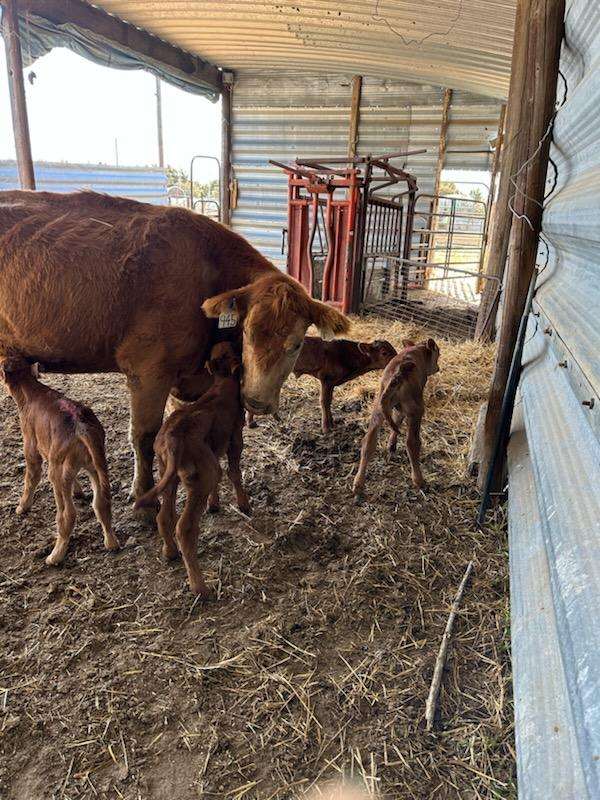
-
The Nebraska “Quad Mom” was naturally serviced last summer in a single sire pasture.
434204245_1092827492009135_6231944486904494310_n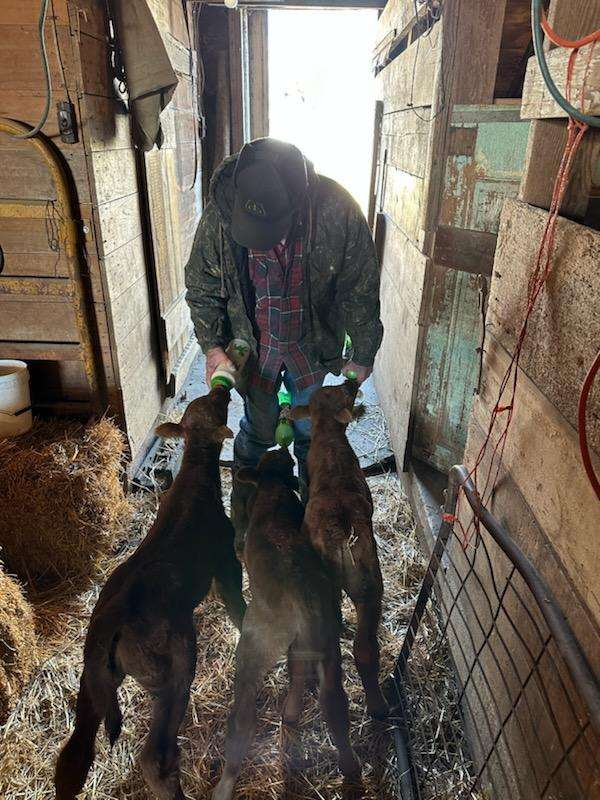
-
-
The quadruplets weighed 30 to 35 pounds apiece; two are bulls and two are heifers.
434166861_331134143275627_5617960084175555861_n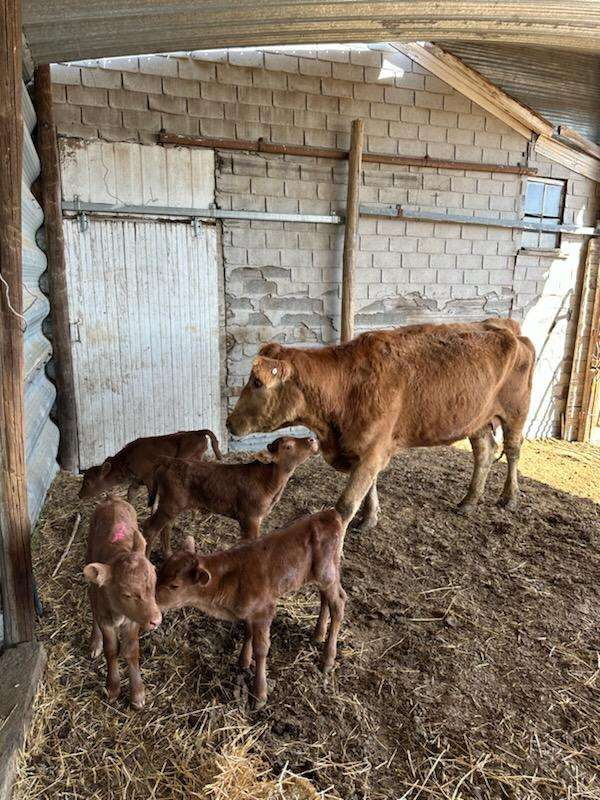
Dr. Jeri Sterner, Merna, Nebraska, has been raising cattle for forty years and she has also been a practicing veterinarian for forty years. But she’s never actually handled a bovine multiple birth beyond twins until this calving season.
“I’ve known of a couple of sets of triplets in the region, but I never been around one,” she said. “I’ve always thought that some time when I go to untangle a set of twins there’s going to be another one, but it’s never happened till now.”
One of Dr. Sterner’s own cows, a five year old Red Angus, gave birth to quadruplets earlier in March.
“It’s amazing,” she said.
The odds for a quadruplet pregnancy in cattle are one in 700,000. The stats for a live birth of quadruplet calves? One in 11.2 million.
“My cows are just range cows; they don’t get a lot of special treatment, we calve two bunches of cows on cornfields and they mostly just get along out there without a lot of fuss.”
Her hired man, Joe Cool, calves one bunch and she keeps an eye on the other group. He called her to come look at a calf. It was pretty little, and although spunky, the night time temperatures expected would have been too much for the little guy, so they headed the cow for the barn.
“The little snot was trotting right behind mommy and he had already sucked; he didn’t need help,” Dr. Sterner said. “When we took her in I reached in and checked, and said, ‘Here’s your twin.’ We flopped him out, and got him on the ground and got him stimulated.”
This calf was just a little bigger, but Dr. Sterner reached back into the cow to make sure everything was as it should be.
“I go back in and there’s another one.”
Besides the number of calves, their vigor also amazed her.
“These are aggressive, hyperactive little devils,” she said. “They were all getting on their feet and trying to suck our fingers. There was nothing little and dumb about them.”
She sent the hired man to get a four wheeler so they could move the babies to a better location, and they were so eager to get going that they kept falling off the wagon.
“They were going a hundred miles an hour,” she said.
While Joe was trying to get the calves situated for their ride, Dr. Sterner went back in the cow for one more feel around.
She felt another calf.
“That was it when we were just like, ‘Really?!'”
Two bull calves and two heifer calves, two weighing 30 pounds each and two weighing 35 pounds each all emerged from one mother.
“They weren’t tangled up, I just brought one out and the next one floated up; every time I reached in there were front feet and a head. I’m sure she would have had them fine, but it was already below freezing that evening when we took her to the corral.”
If the quads had all been born out in the cornfield, Dr. Sterner doesn’t think they would have made it.
“We’d have been sick to get out there the next morning and find them dead,” she said. “They’re just little snots, and don’t have the body mass to keep warm.”
Dr. Sterner’s 93 year old father has been helping bottle feed three of the calves.
“He’s never seen anything like that either,” she said. “The amazing part is that they are all alive and doing well. They’re just like children; they grow like a weed.”
One calf got to stay with their mother, and although she “pulled down pretty hard” after birthing quadruplets, she did clean the following day and is picking up again. The other three calves are getting four bottle feedings per day. When the calves were a few days old, Dr. Sterner put them back with their mother to take a picture of them.
“She claimed all of them, and they all went to go to suck on her,” she said. “She’s just a normal Red Angus cow, serviced naturally by a bull in a single sire pasture.”
Dr. Sterner said that the dam was likely AI bred as a replacement heifer, but after that has only been bred by natural service, and has had no hormones.
“Now my neighbors are telling me that I broke the cattle market with having this ‘litter’ of calves,” she said.
Dr. Sterner is continuing through calving season, dealing with the normal issues of spring blizzards and mud. And she’s getting lots of calls about her quadruplets.
“Nobody has offered to come help with the two a.m. feeding yet,” she laughed.