Co-op model expands livestock processing in Montana
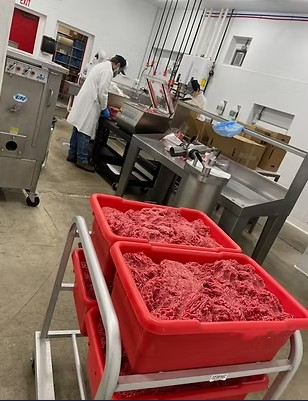
Ranchers in Montana are continuing to benefit from two cooperative-owned animal processing facilities that offer multi-species slaughter and value-added services in the state.
Glacier Processing Cooperative and Montana Premium Processing Co-op were started under the guidance of Montana Farmers Union, which offered training for co-op leadership, as well as helping to facilitate start-up funding.
Both facilities are expanding their member benefits, from a recent full USDA inspection approval at Glacier Processing to the addition of value-added product services at Montana Premium Processing in Havre.
Glacier Processing Cooperative, located near Columbia Falls, is also planning a building expansion, according to Board Chair Mark Siderius.
“We are working on an expansion that will allow us to process 3,000 to 4,000 head a year, compared to the 1,500 a year we do now” Siderius explained. “We will have a new building with an aging cooler, processing, packaging and value-added processing to replace the old buildings.”
The current Glacier Processing facility was formerly Vandevanter Meats, a family-owned business that sold to the cooperative in 2022. The plant processes beef and pork for members and non-members, as well as lamb, goat, and wild game exclusively for co-op members.
The Glacier Processing Cooperative currently has 45 members who each contributed the required $7,000 to the co-op. Membership offers a discounted processing rate, guaranteed hook space at the facility and the opportunity to elect board members and vote on bylaw changes. In the future, co-op members will also be eligible to receive a dividend payment when the plant reaches a certain level of profitability.
“The co-op members own one share of the company and as an owner, members get a say in how this business transforms and operates,” he said. “You also have the ability to dialog about what your processing needs are.”
Glacier Processing is owned by the co-op and governed by a board of directors. Day-to-day management of the plant is handled by paid staff with the board assisting on some key issues and handling expansion efforts.
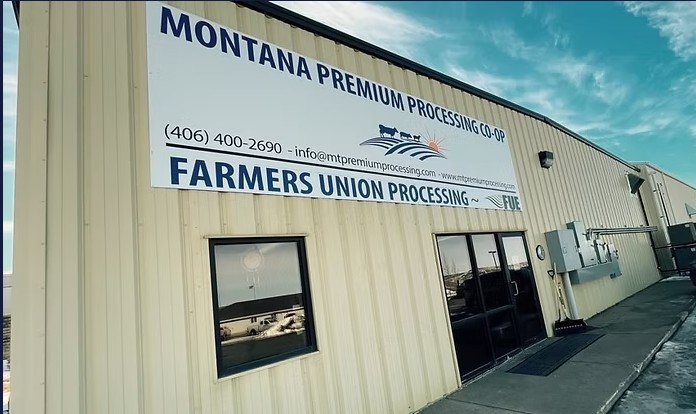
A second cooperative also started by Montana Farmers Union, Montana Premium Processing Co-op, has 70 members and processes beef, pork, lamb, bison, goat, and mutton.
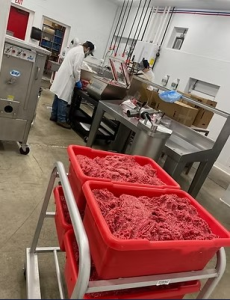
The co-op recently added value-added processing services with the ability to make beef sticks, beef jerky, hams, bacon and other products for customers. Other specialties include a variety of bratwurst flavors including cheddar, jalapeno cheddar, cranberry mozzarella and blueberry cheddar. All products are vacuum sealed, frozen, and boxed for customers. Producers can also add their own custom logo to products.
Members of the Montana Premium Processing Co-op pay $5,000 per membership with many of the same benefits as the Glacier Processing Co-op, including member pricing on services.
“As a member you have control of your own destiny,” said Board Chair Walter Schweitzer. “You elect your leadership and have a say in what is happening.”
Schweitzer said to become a member, producers need to own livestock and commit to using the facility.
The facility has the capacity to process more animals than the 20 per head a week currently being processed, but he noted that finding and training labor can be a challenge in the Havre area.
“We can find people, but often we have to train them and training usually needs to be done one at time to keep the flow of things going, but retention has gone well,” he said.
Recently both facilities have had a slight downturn, with high live cattle prices making it possible for producers to sell live cattle with nearly the same profit margin as direct meat sales. But Siderius said there are still lots of operations looking at how to improve their marketability into the future.
“Interestingly, our first wave of members to our co-op in Columbia Falls were people in their 70s and 80s who were joining to ensure that the facility was going to be there,” he said. “When the prices drop in the live cattle market, the demand for processing is going to be coming back and the demand for hook space will be worse. Already in our area two other small processors have closed, so a lot of our members assessed what their needs were and knew that having hook space was going to be a part of their ongoing business model.”
In addition to helping producers plan for the long term, a co-op membership is something that older producers can hand off to the next generation, Siderius explained.
“This also gives people something that can be part of succession planning or an estate plan,” Siderius noted. “The younger generation is excited about direct marketing opportunities, and they have the skills to build something with it.”
In addition, Siderius said cooperatives are focused on the well-being of their members, not just profit alone.
“We are there to serve our members and do what is best for our members, as well as being aware of how our decisions affect our employees,” he said. “We want to be able to work as a team and be a place where people want to work.”