Drought-resilient crop options for Nebraska corn-soybean growers
Nebraska is heading into the 2026 growing season with limited precipitation and groundwater resources. Growers are also facing rising input costs and declining commodity prices, forcing many to rethink how much risk they can afford to carry with irrigated corn and soybeans.
“In years like this, even small shifts in cropping strategy can help protect both yield and profitability,” said Dipak Santra, Nebraska Extension Alternative Crops Breeding Specialist at the University of Nebraska-Lincoln Panhandle Research Extension and Education Center. “Alternative crops such as proso millet and field pea offer lower water and nitrogen requirements, making them potential tools for reducing risk in water-limited systems.”
Water limitations are not the only concern for farmers this season. The risk of yield loss could be exacerbated by skyrocketing N-fertilizer prices resulting from the war in the Middle East. The U.S. fertilizer industry depends heavily on imports, and the nation’s prices have reportedly jumped roughly 32 percent in the past few weeks. Prices are expected to rise if the international crisis is prolonged.
“With spring planting approaching, these price increases present additional challenges for producers already managing tight margins,” said Rituraj Khound, UNL post-doctoral research associate. At the same time, corn and soybean market prices have declined by 50 percent and 40 percent, respectively, since 2022.
Santra and Khound suggest growers consider alternative cereal millet (proso millet and/or grain sorghum), a crop recognized for its ability to efficiently utilize moisture for producing a considerable yield. Its shallow, fibrous root system effectively takes up early-season water from the topsoil while conserving deeper soil water for subsequent crops.
“Another crop, field pea, is a widely grown pulse crop that is gaining popularity in Nebraska and global health food markets as a source of plant proteins due to its nutrient-dense seeds,” Santra said. “It is also suitable for animal feed as soybean.”
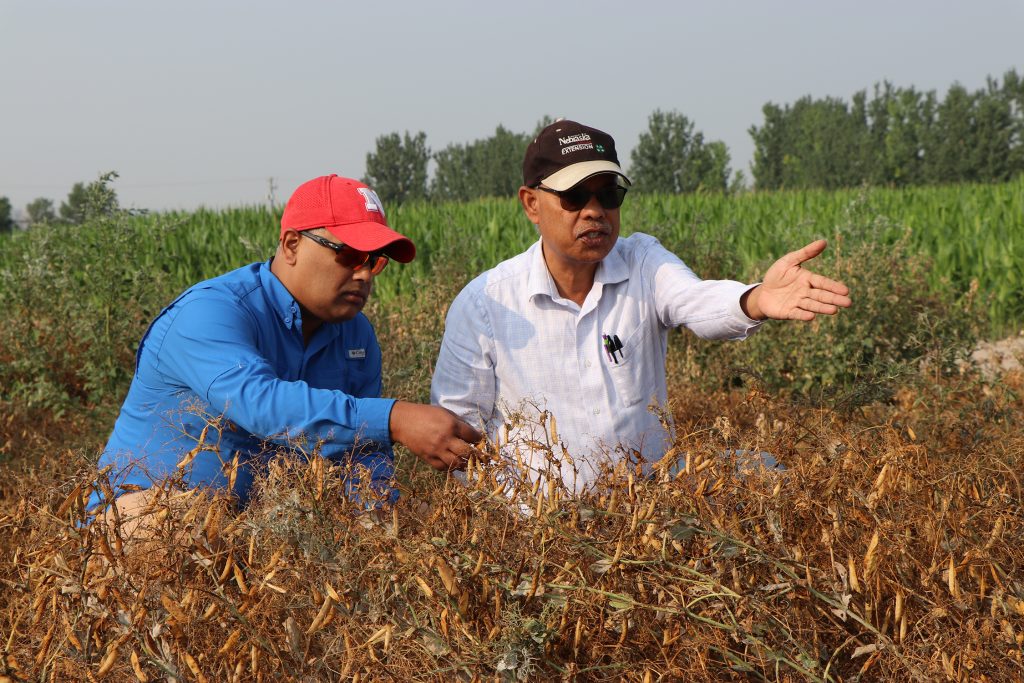
Field peas provide several advantages. Biological nitrogen (N) fixation, enhanced rotation efficiency with cereals, reduced fertilizer requirements, and adaptation to semi-arid conditions due to its early maturity and low seasonal water use. Field pea also helps interrupt common disease cycles when introduced into cereal rotations.
Nebraska is among the states with notable field pea production. In 2025, USDA NASS cited Nebraska farmers harvested approximately 566,667 bushels of field peas from 20,000 acres of farmland.
Dryland millet and peas are both low-input crops that require considerably less seasonal precipitation and minimal fertilizer and herbicide applications, thereby reducing production costs.
In addition to lowering input requirements, both crops contribute to soil health. Field pea supports soil fertility through biological nitrogen fixation and enhanced soil microbial activity, while millet increases soil organic matter deposition, improves soil aggregation, and helps reduce erosion. Together, these crops offer a practical way to improve system resilience and maintain productivity in water-limited environments.
In the face of a challenging growing season, Nebraska farmers could consider diversifying their farms by planting a small portion (e.g., 10-25 percent of the total acreage) of corn with millet, depending on feasibility and resources available on their farms. A similar approach could be used to reduce risk in soybean systems by allocating a portion of acres to dryland field pea.
-University of Nebraska–Lincoln