Nebraska Extension urges scouting after beet armyworm observed in sugar beet
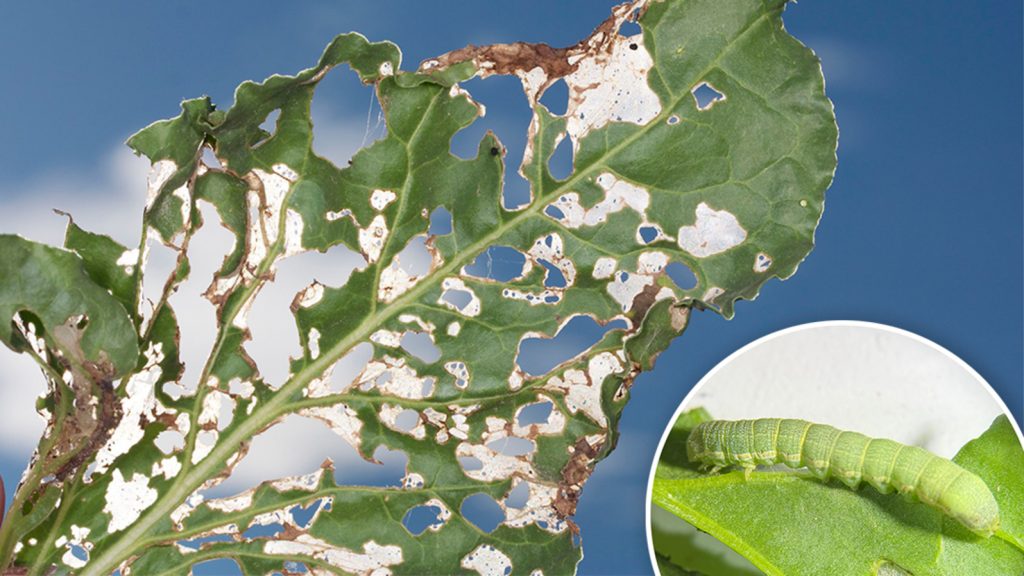
On June 18, 2026, Nebraska Extension received a caterpillar sample collected from sugar beet for identification. The caterpillar was suspected to be a beet armyworm larva but lacked the distinctive black dot behind the head (Figure 1). Although identification is still underway, continuous feeding and defoliation have been reported in sugar beet fields with the presence of those caterpillars. Although confirmation awaits adult moth emergence (specimens currently in the pupal stage, Figure 2), it is reasonable to suggest that it may be an unusual-looking beet armyworm or a closely related species feeding on sugar beet in Scotts Bluff County.
Interestingly, one larva collected may have been parasitized as evidenced by likely parasitoid fly pupae.
Scouting for armyworm caterpillars in sugar beet and dry beans is highly recommended.
Insecticide application decisions should consider the degree of defoliation (more than 50%), presence of egg masses and small larvae (less than ½-inch long), and their density in the field.
If only large larvae are found across the field, the majority of the feeding damage has been done. Insecticides should mainly target egg masses and small larvae to prevent further defoliation.
Identification
The adult moth resembles many of the small noctuid or “miller” moths found in this region — mottled forewings with light-colored to white hind wings.
The small white eggs are laid in a cluster and covered by a cottony material on the undersides of leaves.
The larvae can be light to dark green and are characterized by a black dot behind the head. Multiple sizes of beet armyworm larvae are typically found on the same plant.
Biology
The beet armyworm is native to Asia; however, it has been introduced worldwide and can be found anywhere its hosts are grown. Its host range is broad — it is destructive to more than 90 plant species — and includes cereals, sugar beets, asparagus, corn, potatoes and beans. Although corn is listed as a host, beet armyworm is uncommon in corn.
It is not known to overwinter in cold climates but is thought to migrate northward each year (much like its cousin the fall armyworm, Spodoptera frugiperda), and recent studies indicate migratory patterns from South Florida and the Caribbean, with northward movement during the crop season (Calixto et al., 2025).
It is highly likely that our unusually warm winter this past year has contributed to a more northerly survival of this insect. In regions where this insect overwinters, it will survive in the soil as a later instar larva or a pupa. As the soil warms in the spring, moths will fly for a longer period, very similar to army cutworm or “miller” moth activity.
Beet armyworm moths can develop from egg to moth in 21-24 days and a cold period is not required to complete development. As long as it’s warm enough, this moth can continue producing additional generations.
Small larvae will feed primarily on leaf tissue, leaving only the cellophane-like leaf epidermis behind (Figure 6). Larger larvae will consume larger areas of leaf tissue and may burrow into thicker stems, or even the beet root or bean pod.
Note that if large larvae burrow into beet leaf petioles, this damage may result in flagging (or die-off) of large portions of the leaf.
Scouting
There are no thresholds for beet armyworms in beets or beans. A nominal threshold of 25% is used in cabbage and may be an adequate threshold for defoliation in sugar beet.
Beet armyworms are known to be voracious feeders and can consume large amounts of plant tissue over just a couple days of warm weather. As the larvae grow, their feeding rate increases dramatically.
Larvae are more active feeders at night and may not be visible on leaves. Instead, larvae may be more likely found hidden in the crown of the beet (Figure 7) or in shaded, cooler parts of the plant during the heat of the day. Larvae may lightly web leaves together to protect themselves from the heat or predators (Figure 8).
Beet armyworms can get into bean fields, especially in association with pigweed, which is an alternative host for this species. It will be important to watch for beet armyworm in most western Nebraska crops.
Management
Few insecticide labels include efficacy information specifically for beet armyworm in sugar beet. Control may be unsatisfactory with many widely used insecticides, as this insect has developed resistance to many commercial insecticides throughout the world. Migratory populations of this pest come from high-input regions of tomato and other vegetable production in southern U.S. states, which is reflected in high levels of insecticide tolerance and even resistance in insecticide groups, including carbamate (1A), organophosphate (1b), pyrethroids-pyrethrins (3A), and diamides (28) (See the Insecticide Resistance Action Committee website). Newer chemistries may provide better control. To avoid further resistance development, rotate product chemistries.
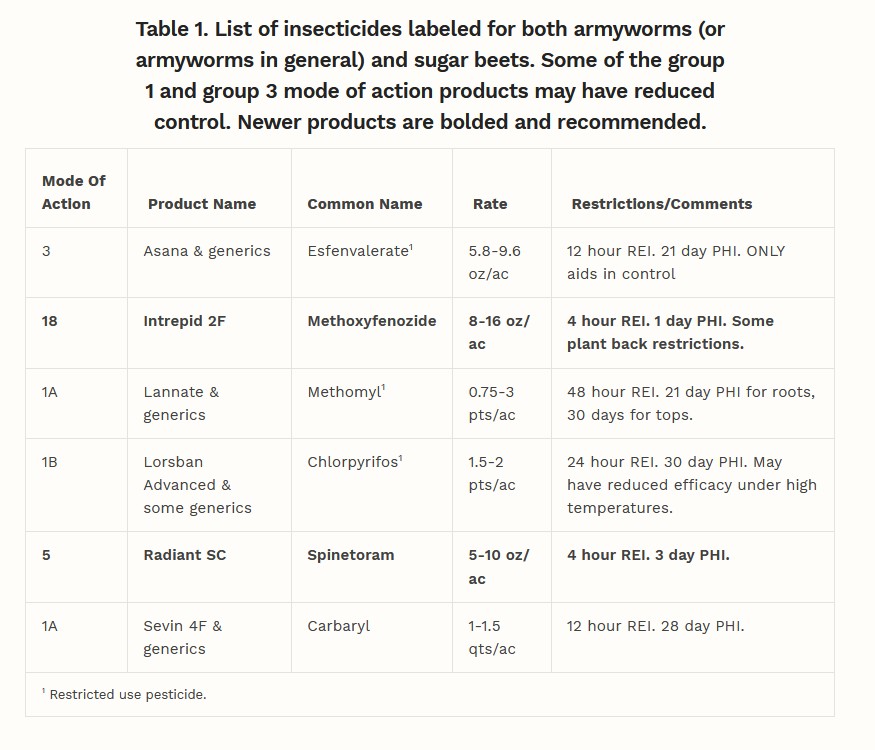
Currently, the best chemical control options (i.e., products for which beet armyworms are less likely to have resistance) cost $27–$60 per acre. This cost does not include the applicator or surfactant costs.
When reading the product label, pay careful attention to surfactant requirements and water carrier recommendations as coverage can be particularly important for effective control. While it’s not recommended to use carbamate, organophosphate, or pyrethroid insecticides due to resistance concerns, note the pre-harvest intervals that could limit early-harvest contracted beets.
-University of Nebraska-Lincoln