Out West Events 2026 | Carly Green: training the rodeo athlete

-
Goat tiers are Green’s passion, and her clinics give her the chance to connect both aspects of a “rodeo athlete.”
CG2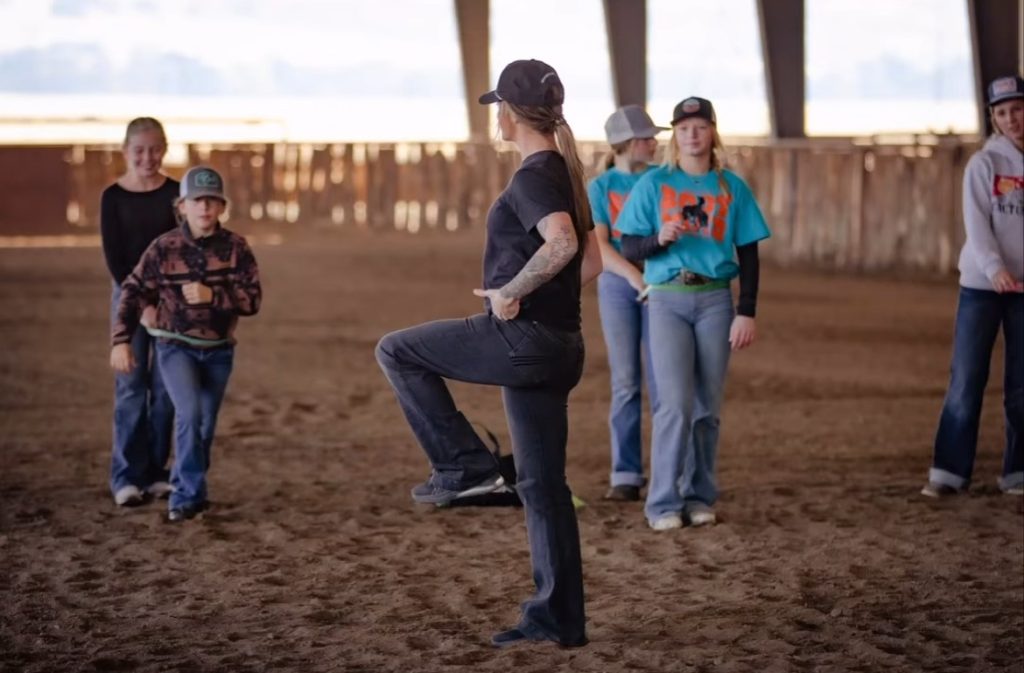
-
Junior high short go competitors warming up with Green.
CG3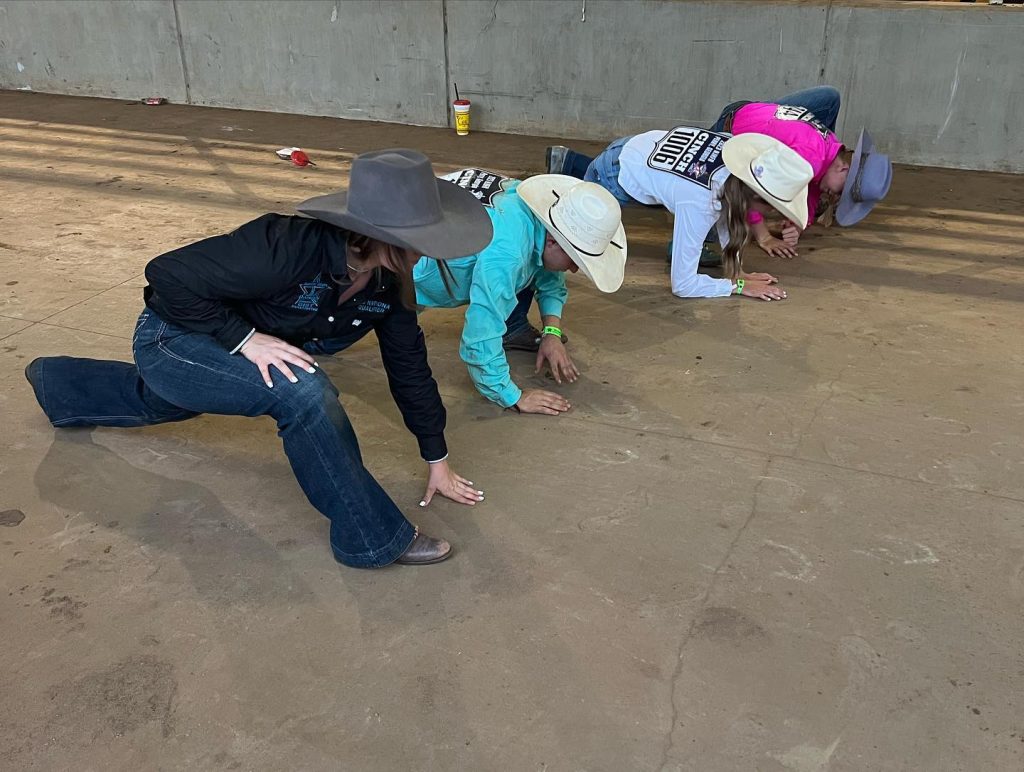
-
Green had a successful college rodeo career until a serious injury in her junior year. However, the setback inspired her to pursue her current career.
CG4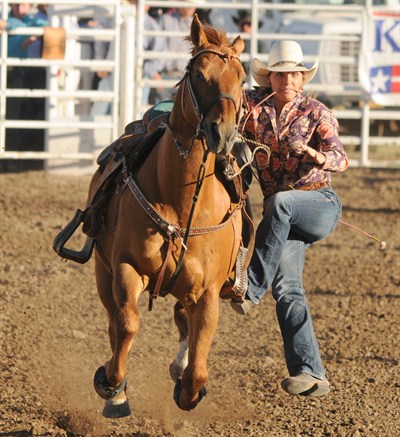
-
-
Not just a goat tier, Green also had success in breakaway roping, including qualifying for the American the first year breakaway was added.
CG5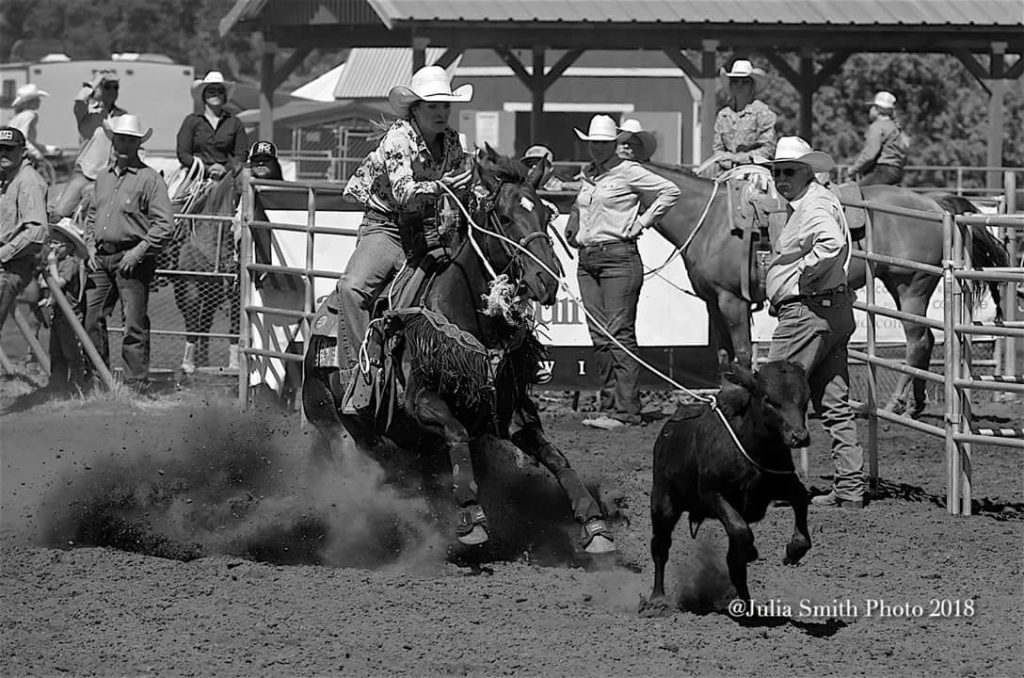
-
Green puts on goat tying clinics throughout North America.
CG1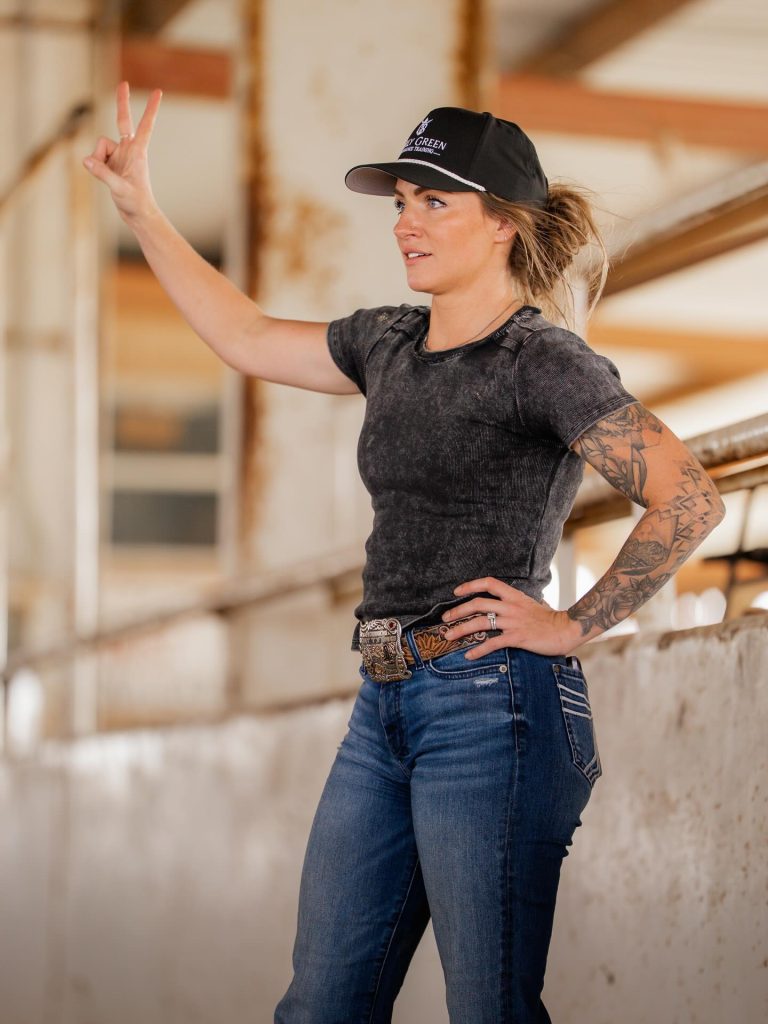
The sport of rodeo so rapidly evolves that inches and tenths of seconds matter more than ever. Times are faster, bucking stock is stronger, and prize money is increasing. Professional rodeo athletes are optimizing their athleticism with time in the gym and personalized training regimens.
This new emphasis on athleticism is paving the way for rodeo-focused trainers to dedicate their careers to improving rodeo competitors. Carly Green of Lindale, Texas is one such coach.
While rehabbing from a serious goat tying injury in college, Green noticed a “gaping hole” in the industry between the weight room and the arena. Carly Green Performance Training is laser-focused on bridging the gap from injury back to competition.
Just as important is injury prevention, or what Green refers to as “prehab.”
“It’s not physical therapy, but it’s geared a lot like physical therapy, just without the injury.”
Carly Green Performance Training
The current iteration of Green’s business is multi-faceted. The vast majority of her clients are virtual, but she also trains in-person clients and teaches goat tying clinics across the globe.
Since branching out on her own in December, Green has had more time to teach her favorite event – goat tying. She puts on clinics wherever she is requested, including Hawaii and Mexico recently.
Clinics are the perfect opportunity for her athletic training to be directly applied to the arena.
“I absolutely love getting to train [goat tiers],” Green said. “When we work on sprint form or we work on how to decelerate or make a corner and we practice it on a cone drill or a body exercise, then I take them straight over to the goat and I make them feel that so that they start connecting those dots and start moving more like athletes in their run.”
Her day-to-day work is done online.
“90% of my athletes are virtual,” she said. Early mornings Monday through Friday, Green hosts Zoom calls where she and her clients work on athletic skills related to rodeo.
Numerous professional rodeo athletes fill her roster, including Leandro Zampollo and Marco Rizzo, who are ranked top 15 in the PBR standings. Some of the PBR athletes are non-English speaking Brazilians, which can be a challenge when training virtually.
“We’ve had to get pretty creative, but it’s going amazing.”
Several PRCA cowboys, including bull riders and tie-down ropers, train with Green in person.
Green believes there are three main “lanes” to cover in rodeo performance training.
“The first one is the foundation,” she said. “Do you move well? Is your core strong? Do you have good range of motion, good balance, good mobility? Those pieces that help make the foundation, because if that foundation isn’t solid, then you cannot perform at your peak.”
Strength and power make up the second lane.
“An athlete’s got to be able to be strong in order to move powerfully,” she said.
The third consists of central nervous system training.
“I used to think you were either born with the speed that God gave you and he either blessed you with a lot of it or maybe none of it,” Green said. On the contrary, speed, reactivity, and processing skills can be enhanced when this training is applied.
“The central nervous system part of it is so fun because you get to tap into athleticism they didn’t even know they had,” she said.
Forged in fire
Green’s path to entrepreneurship was filled with overcoming hardships and consistent hard work.
Raised in Oregon, Green was not exposed to horses until she was around eight years old. She and her identical twin sister were obsessed. “Then we just wouldn’t shut up about getting a horse. We wore them down and eventually we got our first horse,” she said.
From there, gymkhanas turned into high school rodeos. To be competitive was a steep climb, as Green felt she was “behind” her competitors. However, she and her sister “practiced all the time” and made up ground quickly.
Green received a scholarship to rodeo for Colorado Northwestern Community College. There, one anatomy and physiology teacher would change the course of her life.
“She was super into fitness. She ran marathons. She hiked mountains that were 14,000 feet, and she just made this anatomy and physiology class really interesting. I started falling in love with human systems,” Green said.
Green transferred to McNeese State University in Lake Charles, Louisiana, where she dove headfirst into her kinesiology degree and dedicating more time to the gym and the practice pen.
“I just honestly fell in love with it,” she said.
By her junior year, she felt her rodeo career was coming together. At the time, she was sitting third in the Southern Region, known for being competitive.
During a Monday night goat tying jackpot, Green sustained injuries after a hard fall at top speed. “I wrecked so hard. I blew out my knee, I broke my arm, I lacerated my kidney,” she said. “I was devastated.”
The surgery to repair her ACL was successful and she completed rehab, but there was still a gap from the physical therapist back to competition.
“I did not have a good experience with physical therapy. It’s not that they were bad, but their job was to make me functional again, and that’s what they did, but I was not confident on it. There was just something missing with that bridge back to performance,” Green said.
A second surgery was necessary, exactly one year after the first.
“I had almost dedicated a year of training and getting strong again and then felt like the rug was ripped out from underneath me,” she said.
“I feel like God uses all those people, places, and events to write your story.”
Green saw that injury prevention and injury recovery programs for rodeo athletes was sorely lacking. She began asking questions.
“Why is there not more injury prevention and performance enhancement training in the sport of rodeo, and why do we not have people that are specialized in this bridge back to performance? These are huge gaping holes in this industry that need filled.”
For example, when her injury occurred, she was required to do a CrossFit workout consisting of 300 squats prior to her jackpot.
“Talk about a big mess up in programming. That stuff started to matter to me a lot more, especially with what I had been through,” Green said.
Leveling up
Green received her bachelor’s degree in Sports and Wellness Management from McNeese State University. She then received a full ride scholarship to rodeo for the University of Wyoming while pursuing her master’s degree.
Nearing the end of her education, Green became aware of an elite training gym located in Texas called Athletic Performance Enhancement Center (APEC).
“What was cool about APEC is that they didn’t just train the general population. They did athletic development training for little kids all the way up through college, but they also had a huge NFL and MLB roster and a handful of Olympic level athletes,” Green said.
At the time, Bobby Stroup owned the gym. Stroup is well-known now as being the personal trainer for Patrick Mahomes for his entire career.
Green arranged a short “internship” of two weeks with APEC, which she treated like a job interview. Her daughter was nine months old at the time, and a longer internship was impossible. However, Green brought her daughter and mother with her to Texas and she completed her time.
In the end, Stroup told her, “We love what we saw. We want you here.”
The decision to move their family to Texas was a difficult one, as Green’s husband Anthony was a native of Cheyenne, Wyoming.
“He misses Wyoming, but he’s grown to love it here. And he’s very on the same page in the sense that this is where the Lord led us. And he’s really thankful for that,” she said.
When Green settled in at APEC, she was coaching adult athletes.
“There was no rodeo class, which is typical. You don’t ever walk into a gym where they have a program for rodeo athletes – that just doesn’t exist. I really, really wanted to create something, especially because the need is so big.”
She launched a virtual platform where she began coaching goat tiers.
“This is what I’m most passionate about. I just want to help these girls not get injured, and if they were injured, help them come back to being confident and ready to perform again.”
Green received pushback from the gym but insisted on the importance of working with rodeo athletes. They came to the agreement that Green would only work with rodeo athletes on her own time.
For two years, she fed into this passion project and the program grew, despite daily challenges.
“My daughter was a year-and-a-half at the time, and she was not sleeping through the night. I was having to wake up at 3:00 in the morning to go open the gym and then try to do this business on the side.”
When new ownership took over the APEC gym, they were impressed at the numbers of rodeo clients Green had amassed through her virtual platform. She was given the opportunity to coach solely rodeo athletes.
“We want you to just take this and run with it,” the new ownership told her.
“The very first month that they did that, my clientele doubled. It just exploded because I was able to finally travel and connect with more people and promote this more.
“Now it’s so humbling because I feel like the Lord was who brought the opportunities, the Lord was who supplied the timing, the Lord was who brought the right people. And now we’re almost in every state, but we’re also in Canada, Brazil, and Australia and Mexico,” Green said.
At the end of 2025, Green struck out on her own and is now the sole operator of Carly Green Performance Training.
The future
Green sees rodeo athletes tending to focus more on their performance training than ever before.
Green regularly hosts free training sessions at youth rodeo finals, such as the National Little Britches Finals Rodeo.
Sometimes, she receives feedback from parents.
“I had more than one old school rodeo parent that would say, ‘Why would you train? If you want to get better at a rodeo event, just go practice more.’ And I think that that’s been a really common kind of idea in rodeo for a really long time.”
Practice in the arena certainly contributes to success. However, it can come at a cost, said Green.
“You run into overuse injuries, you start breaking down and wearing down your body, and there’s got to be something that combats that. In the gym, not only can we extend your shelf life as a rodeo athlete, but we can control the variables in a way where you get faster and more reactive and can train in a more elite way than what you can do just in practice. Essentially, your job in the arena becomes easier based on how you train.”
What matters
While Green seeks success for herself and others in the arena, she does not lose sight of the important things in life.
“I love what I do. Yes, I want to see athletes thrive in the arena. Yes, I want to see times and scores that we’ve never seen before because we’re tapping into athletic potential. But I think more than anything, I also just want to share the Gospel and share God’s love with people that I meet and I come across.
“As much as we all love rodeo, the time that we have on this earth is all preparation for the big rodeo, the biggest stage of all, which is eternity with the Lord.”
Green continues to reside in Lindale, Texas with her husband Anthony and their two daughters, Benzley and Presley.
Her work can be found at Carly Green Performance Training on Facebook and Instagram.