Screwworm spreads, Senior Advisor appointed, interstate animal movement requirements
On June 3, 2026, the U.S. Department of Agriculture’s (USDA) Animal and Plant Health Inspection Service (APHIS) confirmed the detection of the first case of New World screwworm (NWS) in the umbilical area of a three-week-old calf in Zavala County, Texas. This was the first confirmed case of NWS in the United States since the pest began moving northward into Central America and Mexico in 2023.
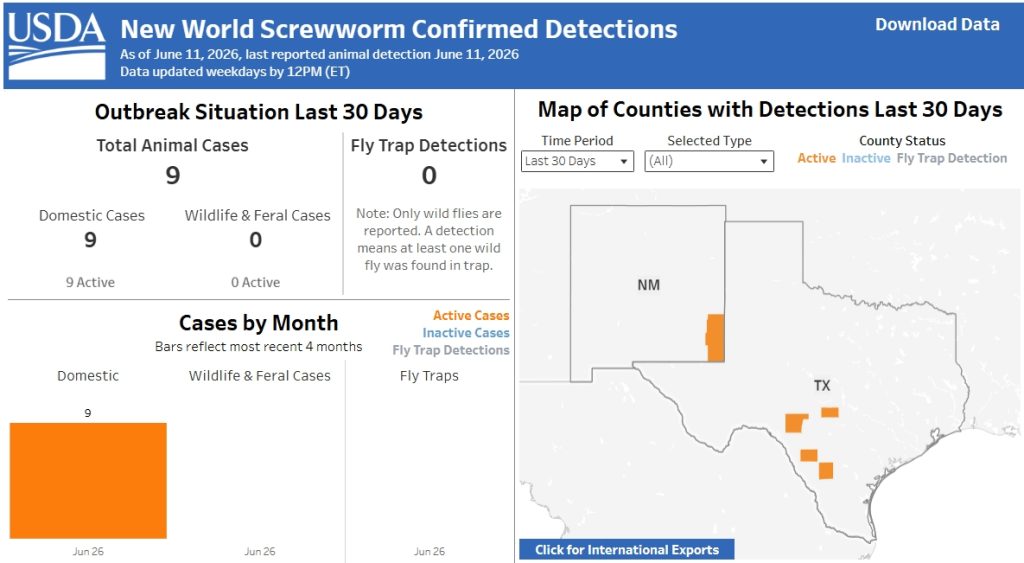
As of June 11, nine cases of NWS myiasis have been reported and confirmed in the U.S. Six cases have been confirmed in Texas cattle, two in goats, also in Texas, and one case of NWS was reported in a dog in New Mexico. The Texas Animal Health Commission (TAHC) has established a quarantine due to the established New World Screwworm Infested Zone in parts of the following Texas counties: Edwards, Gillespie, Kerr, Kimble, La Salle, Sutton, Uvalde, Val Verde, Webb, Zavala.
According to the Executive Director Orders issued, all warm-blooded animals in a zone may not move out of the zone without prior authorization from the TAHC.
Warm-blooded animals moving outside of an infested zone must contact the TAHC to set up an inspection. During this inspection, an animal health official will fill out an animal movement certificate listing the product used for prevention or treatment and the animals’ official ID. This certificate will need to accompany animal movement. Additional guidance can be provided during an initial inspection request call to TAHC.
TSCRA
This week, Secretary of Agriculture Brooke Rollins joined Texas & Southwestern Cattle Raisers Association leadership and industry partners in South Texas to discuss the response to Texas’ first confirmed cases of NWS. Sec. Rollins and newly appointed Senior Advisor John Bellinger visited Rock Creek Ranch, LaPryor, Texas, where they saw the calf recovering from the first confirmed case of NWS. Sec. Rollins spent time in the saddle, putting her own eyes on livestock and listened to producers’ concerns and questions. Federal and state level team members discussed what worked during the first days following detection of NWS in U.S. livestock, and learned about sterile fly ground release chambers in the area which provide additional support along with sterile flies being dispersed via air drops.
“The response to Texas’ first confirmed case showed why early detection and timely reporting matter,” TSCRA stated on social media. “When producers stay vigilant and report suspicious wounds, state and federal animal health officials can respond quickly.
“TSCRA has been proud to work alongside ranchers, landowners and agency partners throughout the response, helping share critical information, connect those on the ground with resources and advocate for the tools needed to stop New World screwworm.”
Bellinger named Senior Advisor of New World Screwworm Preparedness
U.S. Secretary of Agriculture Brooke L. Rollins announced on June 8, 2026, that President Donald J. Trump appointed John Bellinger as the new Senior Advisor for New World Screwworm Preparedness. Bellinger will assist the USDA team’s effort to explore all available technologies to combat the New World Screwworm.
“I want to thank John for joining our team as USDA transitions to the next phase of fighting and eradicating this pest from our borders, as we did nearly sixty years ago, yet it came back due to Biden’s failed open border policies,” said Secretary Rollins in a press release. “John’s roots in Texas where New World screwworm is at ground zero, and his private sector experience in the related food safety and cattle industries, will help the administration advance our response and protect U.S. livestock.”
“New World Screwworm presents unique challenges to America’s ranchers, and Secretary Rollins has taken dramatic steps to work on building up our domestic response to this pest. USDA is responding in real time and building up long term capabilities to push back New World Screwworm beyond our borders and past the Darien Gap,” said Senior Advisor Bellinger. “I look forward to working with USDA and our state partners as continuing ramping up testing, detection, and release of our tools to reduce these flies’ populations.”
According to USDA, John Bellinger currently serves on the Texas A&M Board of Regents after being appointed by Governor Greg Abbott in 2023, where he serves as Chair of the Committee on Research. He resides in San Antonio and is the co-founder, with his wife Gina, and the former CEO of Food Safety Net Services (FSNS). He is currently a board member of the recently merged company between FSNS and the Certified Group. He is the CEO of Agri-West International food exporter as well as Bellinger Development. He is the former chairman of the U.S. Meat Export Federation and the Southwest Meat Association. Additionally, he is a longtime member and season ticket holder of the 12th Man Foundation. He is also a member of the Texas A&M University College of Agriculture Development Council, as well an adviser to the Animal Science Department. He remains a partner and board member of Nolan Ryan Beef, BK Beef, BC Stables, AW Japan, Just Pots, and Livek. He is the recipient of the 2007 Outstanding Alumnus for Texas A&M University College of Agriculture and the Outstanding Alumnus of Texas A&M University Animal Science Department in 2014. He has also been inducted into the U.S. Meat Industry Hall of Fame in 2022. Bellinger received a Bachelor of Science in Agricultural Education and a Master of Science in Animal Science from Texas A&M University.
Interstate animal movement
Some states, including Montana, North Dakota and South Dakota, have additional import requirements for any animals coming from a state where NWS has been found. NWS can affect any warm blooded species, including livestock, wildlife and pets. Current information as of June 12, 2026, follows, however, the situation is rapidly evolving so checking with your state’s Board of Animal Health for updates and with your local veterinarian prior to any animal movement across state lines is strongly encouraged. The following information is not meant to replace consultation with a veterinarian.
Montana
The Montana Department of Livestock and Montana State University Extension have issued guidance for the Montana livestock industry following the detection of NWS in Texas.
On June 4, the Montana Department of Livestock released an animal health order for livestock traveling into Montana from affected locations. According to the order, animals from an infested state must have an import permit from the Department of Livestock and a certificate of veterinary inspection – or CVI – documenting that the animal has met the state’s requirements to leave an infested zone. The CVI cannot be issued before the initial New World screwworm detection in the infected state. Because animal health authorities in Texas do not have authority over small animals, the order has different requirements for small animals and livestock species.
The CVI must indicate that all animals listed on the document are free from wounds and evidence of New World screwworm larvae infestation, and all animals must have official identification. The CVI can only be issued within five days prior to movement to Montana. These requirements apply statewide for small animals. For livestock, these requirements are applied at the county level. Impacted counties are listed in the order. Animals under this order include all warm-blooded animals, including cattle, horses, mules, other equids, sheep, llamas, alpacas, bison, swine, ostriches, rheas, emus, goats, alternative livestock species, dogs, cats, rabbits, rodents, game animals, fur-bearing and wild animals, and poultry and other birds. More detailed information can be found in the order from the Montana Department of Livestock.
Animals entering the state from any location in and around the infested zone should be monitored for signs and symptoms of New World screwworm infestation. Individuals should contact the Montana Department of Livestock at 406-444-2976 or mtstatevet@mt.gov for more information regarding animal travel within and around the infected zones.
Additional tools and information related to the response to New World screwworm can also be found on the USDA Animal and Plant Health Inspection Service website at https://www.aphis.usda.gov/animal-emergencies/nws.
To learn more about the Montana Department of Livestock animal health order, visit https://news.mt.gov/Department-of-Livestock/Animal-Health-Order-No-2026-01.
North Dakota
The North Dakota Animals coming to North Dakota from any state which has an active NWS quarantine in place are required to be accompanied by a pre-entry permit number prior to import into North Dakota. The permit number is to be listed on the CVI.
USDA and Texas officials are taking immediate action to contain and eradicate NWS from the United States, and the North Dakota Department of Agriculture’s animal health division is working closely with USDA-APHIS veterinary staff and other state veterinary offices, including Texas, to maintain open communication and prompt coordination in any necessary responses.
“If you are bringing animals in from, or traveling into high-risk areas, monitor your animals for wounds. If you notice any suspicious wounds on your animal, have a veterinarian look at it,” State Veterinarian Dr. Ethan Andress said. “Horse owners traveling with an Extended Equine Certificate of Veterinary Inspection (EECVI) should be aware the EECVI will not be accepted from infested states and will require an inspection and CVI with permit.”
Individuals planning to travel to Mexico with pets should visit the USDA-APHIS Pet Travel Website for the latest guidelines.
“When NWS infestations are found, infestations can be treated with several FDA-approved products,” Andress said. “A prompt diagnosis and treatment can prevent significant losses.”
Full details on animal movement and importation requirements may be found on the North Dakota Department of Agriculture’s website.
Those with questions may contact the North Dakota Department of Agriculture’s animal health division at 701-328-2655 or doa-bah@nd.gov.
South Dakota
South Dakota Animal Industry Board has imposed additional restrictions on animal movements into the state following the detection of NWS in the U.S.
All warm-blooded animals originating from a New World Screwworm infested state, but outside an infested zone, shall be required to have a Certificate of Veterinary Inspection (CVI) issued within seven days of inspection. The CVI must include the statement “All animals listed on the CVI have been inspected and are free of screwworm larvae infestation and do not originate from nor have transited through a NWS Infested Zone.” An entry permit is required from the South Dakota Animal Industry Board by calling 605-773-3321 (after hours and online entry permits are not allowed).
All warm-blooded animals originating from a New World Screwworm infested zone must meet the movement requirements of the state of origin and have a Certificate of Veterinary Inspection (CVI) issued within seven days of inspection. The CVI must include the statement “All animals listed on the CVI have been inspected and are free of wounds and screwworm larvae infestation.” An entry permit is required from the South Dakota Animal Industry Board within 48 hours prior to entry by calling 605-773-3321 (after hours and online entry permits are not allowed).
Please contact the SD Animal Industry Board with any questions. • 605-773-3321 • aibmail@state.sd.us
NWS and pets
While most dogs and cats in the U.S. are at low risk of NWS; risk is elevated for pets in areas with recently confirmed cases of NWS. On June 11, the USDA issued an Emergency Use Authorization (EUA) for generic Nitenpyram Tablets (nitenpyram) for the treatment of NWS infestations (myiasis) in dogs, puppies, cats, and kittens that weigh at least two pounds and are at least four weeks old. This is the first generic animal drug authorized for use against NWS, and is an over-the-counter medication.