Iowa: Amendment weakens property protections in HF 2104

Once again, property rights are a hot topic in Iowa.
The Iowa House of Representatives recently passed HF 2104, a bill to prohibit any entity from using eminent domain to gain access to property for a carbon dioxide pipeline. The Senate Commerce Committee then amended the bill to essentially change the intent of the bill. The amended version, which doesn’t restrict eminent domain and actually increases the legal pipeline corridor from two miles to five miles has is now headed to the Senate floor.
Doyle Turner, the lobbyist for the Freesoil Foundation, whose self-proclaimed purpose is “empowering landowners and citizens to stand against land grabs for private gain,” believes the amended version of the bill not only takes away Iowans’ private property rights, but it is also unconstitutional.
“It denies due process in the expanded corridor,” he said. He explained that, if the bill passes as amended, the pipeline location could be adjusted as much as five miles one way or the other without permission from the newly affected landowners.
“This violates the U.S. Constitution and the Iowa Constitution,” he said.
The state of Iowa requires that amendments be “germane” or relating to the subject matter of the original bill. Turner said the amendment was not challenged for possibly not being germane to the subject of the original bill.
All of the Democrats and one Republican – Rep. Dave Rowley – on the Senate Commerce Committee voted against the amendment. The Democrats also voted against the bill, but with 13 Republicans voting “yes,” it advanced on to the Senate as amended.
The Freesoil Foundation led an effort in the 2025 session that would have made it more difficult for companies to use eminent domain when building carbon capture pipeline and other energy infrastructure. Governor Reynolds vetoed that bill, saying the bill went “much further” than than pipelines and “sets a troubling precedent that threatens Iowa’s energy reliability, economy and reputation as a place where businesses can invest with confidence,” she said.
South Dakota property rights updates
After the South Dakota legislature passed and the governor ultimately signed HB 1052 last year to prohibit carbon pipeline companies from using eminent domain to gain access to land, Summit Carbon Solutions reportedly contacted potentially affected landowners again, in a less abrasive tone.
Summit Carbon Solutions was suing over 100 South Dakota landowners to gain easements for their pipeline. Additionally, the company had conducted invasive “surveys” which included drilling and digging, without permission on land across the eastern side of South Dakota.
A Brown County, South Dakota farming couple, Jared and Tara Bossly filed a lawsuit against the company for trespassing on their property in 2023. Jared Bossly told TSLN at the time that his county sheriff instructed him could not prevent the surveying on his land, and he was instructed to remain 300 feet away from the survey crew while they drove across his field and rows of new trees to drill in his corn field.
The South Dakota House passed a bill to amend the South Dakota constitution to prevent the use of eminent domain for economic purposes. This bill came as the result of the many attempts of Summit Carbon Solutions to gain legal standing to take property for its pipeline. The constitutional amendment would protect landowners from other private entities using eminent domain to take property for private enterprises. Spencer Gosch, who sponsored HJR 5001, said this subject has been on his mind for a few years.
“I”ve been looking for ways to adjust or amend this, then the carbon pipeline thing came on our doorstep, and it showed why we need this kind of reform,” he said. “A lot of states have done something like this so we are really kind of behind the times in that regard. We’ve got to defend property rights and put a top to private companies and government taking advantage of private property owners,” he told TSLN. HJR 5001, if approved by both houses, would not go to the governor for a signature, but would go a vote of South Dakota citizens.
The South Dakota Senate approved SB 88 sponsored by Senator Lapka, dubbed the “Bossly bill” would prevent private entities from conducting surveys without permission. However, “examinations” without permission would continue to be legal under certain circumstances, including when a citing permit has been granted.
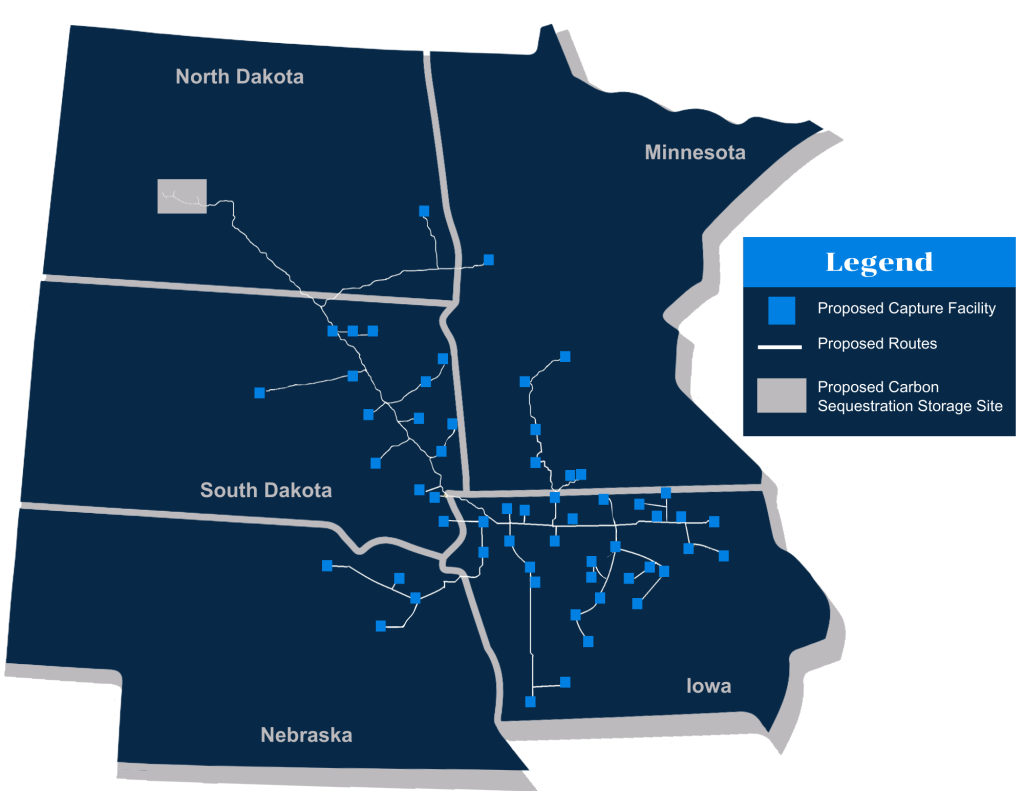
With Summit Carbon Solutions – a private company with foreign investors – targeting Iowa, Minnesota, the Dakotas and Nebraska for an underground carbon dioxide transportation pipeline, those states have been forced to turn attention to the rights of their constituents in dealing with private companies and eminent domain.
The reported purpose of the pipeline is to collect CO2 from ethanol plants in Iowa, Nebraska, Minnesota and easter South Dakota, and transport it in liquefied form to an underground location. The original map targeted the Beulah, North Dakota area as the collection point for the CO2. However, with the South Dakota law that now prevents the use of eminent domain for such pipelines, the original proposed route may not be possible. Federal 45Q tax credits of up to $80 per ton provide the incentive for the pipeline. Earlier Summit Carbon Solutions websites reported investors including the Silk Road Fund and John Deere. The current, scaled back website, doesn’t appear to list investors or include a proposed route map.



UPDATED DAILY: 2025 Wrangler NFR Round Results and Averages
Daily results from each round of the 2025 Wrangler National Finals Rodeo held at the Thomas & Mack Center in Las Vegas, NV | December 4-13, 2025.