MCOOL, State meat inspection: USDA Secretary Rollins shares more details on Presidential plans

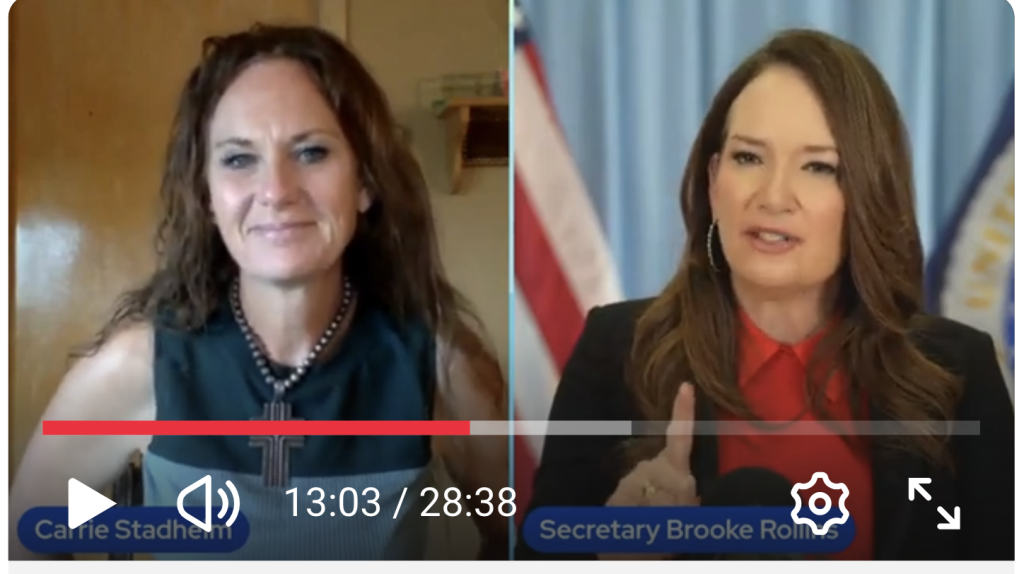
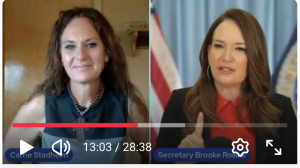
TSLN Editor Carrie Stadheim conducted a video interview with U.S. Department of Agriculture Secretary Brooke Rollins Sept. 15, 2026.
Secretary Rollins gave details on the President’s Sept. 4, 2026, executive orders focused on the Packers and Stockyards Act, beef processing, mandatory Country of Origin Labeling and wolf depredation.
The Executive Orders followed up on a string of stressful headlines. Several packing plant closure announcements seemed to serve the intended purpose of turning cash cattle and futures sharply lower. The reopening of the Mexican border to cattle after more than a year of being closed coupled with the President Trump Truth Social post announcing a deal he had made to allow for the importation of 300,000 metric tons of lean beef in 90 days below quota added to the strain.
Industry analysts from all sectors seem confident, however, that market fundamentals of extremely tight cattle supplies and strong demand remain at play and will keep producers in the drivers’ seat.
State meat inspection
The day after the Secretary spoke with TSLN, USDA rolled out an initiative to support state meat inspection programs. This is intended to give cattle producers and feeders more options for selling their own beef.
The Stand-Up Program will provide $50 million in new funding for states to start or expand their own meat inspection programs.
Thirty-one states maintain state meat inspection programs: Alabama, Arizona, Arkansas, Delaware, Georgia, Illinois, Indiana, Iowa, Kansas, Louisiana, Maine, Minnesota, Mississippi, Missouri, Montana, Nevada, New Mexico, North Carolina, North Dakota, Ohio, Oklahoma, Oregon, South Carolina, South Dakota, Texas, Utah, Vermont, Virginia, West Virginia, Wisconsin, Wyoming.
Of those, 11 maintain approval for Cooperative Interstate Shipment, or CIS: Indiana, Iowa, Georgia, Maine, Missouri, Montana, North Dakota, Ohio, South Dakota, Vermont and Wisconsin.
Shaun Quissell, the North Dakota Grain and Livestock Licensing Division Director helped explain the nuts and bolts of state meat inspection and what this announcement means.
For a states like North Dakota with a currently functioning state meat inspection program, change might be minimal. State meat inspection programs must be at least equal to federal inspection. Meat processed at a state inspected facility is eligible to be sold anywhere within that state, and can be sold in any form – retail, wholesale, food service, etc.
Under the CIS program, state-inspected meat can be sold anywhere in the United States, but is not eligible for export. For North Dakota, the export restriction matters. Quissell said he believes some producers selling North Dakota- inspected beef would probably find customers in Canada if they had the option.
The state inspection program is currently 50 percent federally funded and 50 percent state funded. The CIS program is 60 percent federal and 40 percent state funded.
Only those plants with 25 or fewer employees are eligible to be considered CIS plants.
Quissell explained that North Dakota was an early adopter of the state meat inspection concept because USDA-inspected plants are few and far between in the state. As a result, cattle producers and slaughter facilities asked the state to establish a state inspection program to open up opportunities for them to sell beef.
While Quissell doesn’t expect the Stand-Up program to significantly affect North Dakota, it could have a big impact in states without their own inspection programs.
MCOOL
The Senate Ag Committee passed their version of the farm bill, which will not advance to the full Senate floor. The bill passed in a 12-11 party line vote. Senator Mitch McConnell of Kentucky’s return seemed to propel the bill forward. He cast the deciding vote.
The bill includes a provision for a WTO (World Trade Organization)-friendly mandatory country of origin labeling for beef, championed by South Dakota’s John Thune, a member of the committee.
Democrats oppose the bill over SNAP (food stamp) provisions where states with higher than a six percent payment error rate are expected to supplement a portion of their citizens’ benefits. States with the highest error rates have the option to delay paying penalties for two years. But Democrats believe higher error states should have the option to delay for three years.
Iowa Senator Joni Ernst, a Republican, urged for support of an amendment that would have protected against Proposition 12-style movements. Proposition 12 was a California initiative to prohibit the sale of pork and other meat (and eggs) from animals raised in confinement.
Ernst was denied the chance to bring up her issue. Committee chairman John Boozman said he had already closed the bill to additional amendments before the initial vote in August.
Not surprisingly, R-CALF USA and US Cattlemen’s Association expressed support for the Senate Ag Committee’s action.
USCA said there is still a “long road” in gaining enough votes on the Senate floor to pass the Farm Bill. The group pointed out that it will take a bipartisan effort to get the legislation across the finish line.
“We commend the Senate Agriculture Committee for its recognition that American cattle ranchers deserve the opportunity to compete for consumers who want American beef and that all American consumers deserve to know where their beef comes from,” said R-CALF USA CEO Bill Bullard. “We also recognize our thousands of cattle producer members who have stood behind this effort for years and never wavered in their commitment to restoring MCOOL.
The National Cattlemen’s Beef Association didn’t issue a news release or post on social media following the Senate Ag Committee approval of the Farm Bill. The group has remained opposed to MCOOL for many years. The group’s senior vice president of governmental affairs, Ethan Lane, in an Agriculture of America interview said, “people are really, really going to the mat to take the good out of this supply chain and this market right now for their own political purposes. And it’s really disappointing to see.”
Lane said that under the MCOOL law from 2009 to 2015, “our producers were bearing the compliance costs of those and they weren’t seeing any benefit from it.”
Secretary Rollins on MCOOL
Secretary Rollins told TSLN in the interview that “Americans need to know where their food comes from.”
Rollins said mandatory country of origin labeling of beef is a fundamental concept, alongside building confidence for American cattle producers.
“What can we do to support them and support you?… I believe that moving toward a system that prioritizes American beef over foreign beef…if American moms and dads want to buy American beef and perhaps pay a little bit of a premium, (I know I would) then they should be able to do that,” she said.
Rollins emphasized her awareness that some producers are affected in different ways, such as those who feed cattle from Mexico, but she believes MCOOL can be positive for the entire industry.
A WTO-compliant version of MCOOL is not going to be a problem, she said. She also said she believes new technology will streamline tracking of carcasses and meat items within plants, to minimize any extra cost associated with the program. The Secretary also hinted at the possibility of marking imported meat as “not a product of USA” or something similar even before MCOOL is approved by Congress.
“Now…we’re waiting for Congress to get that passed and again I actually feel confident they will move quickly on this with the President talking about this and me leaning in.”
“The truth is the truth and I will continue to battle for that. And I just feel confident we will get something pretty significant done, while protecting those ranchers that maybe have an across the border business so that they don’t bear the brunt of this. Listen, talk about Make America Healthy Again, we had almost 10 percent more purchase of real food last year than ever before in American history. People are waking up that the demand for American beef is insatiable. Even as the price of beef continues to go up, supply and demand would tell you that, well they will stop buying so much beef, they will move to another protein…no Americans don’t mind paying $6.50 for a pound of ground beef. It is one of the best things you can feed your family, it is so nutritious, nutrient dense, it’s cheaper than my latte this morning, it’s cheaper than a bag of Doritos and a can of Coke, this is real food, and we just have to keep telling that story and while we’re doing it, more and more Americans will continue to buy beef and buy beef that our ranchers are producing. I’m so bullish and so encouraged and really grateful to be at the front end of this whole movement right now.”
P and S, meat inspection
The Secretary also talked about the Packers and Stockyards investigation, saying that one big priority for her is to ensure the packing plants that are closing do not sell to foreign interests. She said she herself is in constant contact with key players to work on keeping the plants in operation.
She is aware that many producers in the Joslin, Illinois area are struggling without a local outlet for their fat cattle.
She emphasized that meat inspection is important to her, and that she is working with governors and agriculture departments across the nation to focus on bettering state meat inspection.
Wolves, rancher mental health, lawfare
Rollins told TSLN that she has appreciated getting to know real producers, and she believes they, rather than lobbyists, can provide solutions. “When they get off their tractor or come inside from feeding cattle, and give me a call, those are the people who truly know what is going on in agriculture,” she said.
“There is a real battle for the soul of agriculture right now and wolves are at the top of the list,” she said.
The Secretary said her agency is digging to find rules and regulations that do allow ranchers to manage wolves in a common-sense manner, and hinted might be “close to an announcement” on that.
The Secretary said she has been working on a leading brain expert who focuses on mental health to elevate the issue of farmer and rancher mental health and the suicide crisis and rural America.
“Not just talk about it and provide a phone number but to actually understand..what can be done. There is a lot more to come from this USDA on that issue. The most important thing we have to do is bring down the cost of inputs, open up world markets, make farming and ranching prosperous and profitable and where they are not just surviving year to year…and understanding the stress these farmers and ranchers are under, and what we could potentially do from a brain perspective to help solve that as well.”
On the lawfare topic, the Secretary said she urges for more property rights-friendly laws. She pointed out that states are in a better position to protect property rights than the federal government. She said she plans to put together a set of guidelines to hlp direct states on passing and implementing property rights-focused legislation in the coming two years.
Full interview: https://youtu.be/VFuvns6yfqg