NDSU Extension specialists provide considerations for virtual fence in grazing management
Fencing is a critical tool for enhancing grazing management through managing livestock access and distribution. However, constructing physical fences, both permanent and temporary, can be labor-intensive and costly. Over the past year, several ranchers in the region have implemented this technology, and many are wondering how it works and whether it fits their operations.
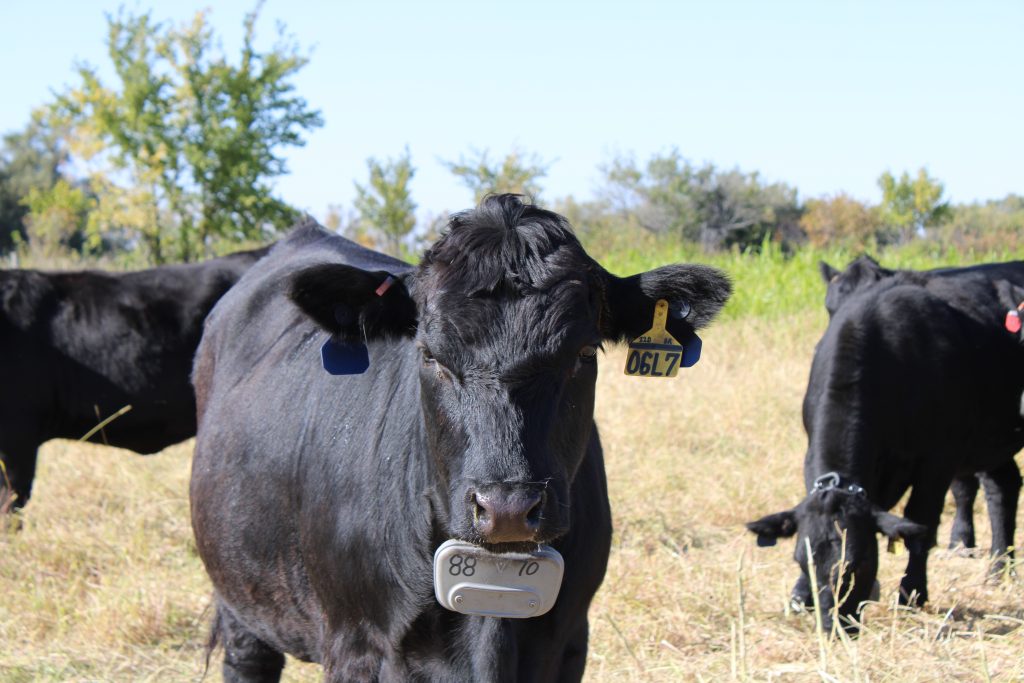
Virtual fencing is a new, fast-growing management tool available to livestock producers and land managers to enhance grazing management without the use of interior fences. A virtual fencing system utilizes digital fence boundaries with global positioning system- GPS-enabled collars to manage the movement of grazing animals.
“While design and connectivity can vary by vendor, virtual fencing systems work through the same principles,” says Miranda Meehan, North Dakota State University Extension livestock environmental stewardship specialist.
A GPS-enabled device is fitted to livestock that communicates its position to an online management platform either via a tower or cellular service. These platforms are used to create virtual fences that contain animals within or outside designated areas, or to move them.
Virtual fence devices use GPS to determine the animal’s position and deliver various cues to manage it. Management cues include auditory tones and electrical cues. Auditory and electrical cues are only administered when an animal enters or approaches the set boundaries. These cues are direction-sensitive and will not activate as animals move back into the desired area. Additionally, electrical cues are limited for animal welfare and deactivated if a cue threshold is met.
Considerations for implementing virtual fence
Before deciding to implement virtual fence, there are some key considerations, such as vendor and product availability, design connectivities, and livestock species.
“With varying cellular coverage, you must consider signal coverage and strength when selecting a virtual fence platform,” says Meehan.
A cellular connection that supports text messaging is sufficient for virtual fencing collars to update. Radio-connected collars can work in more remote areas with limited cellular coverage. These systems require a base station or tower to transmit data, which have limited range depending on topography. Hilly or heavily wooded terrain can limit the line of sight needed for the base station to communicate with the collars.
Battery life can be a limiting factor for virtual fence. Battery life can range from a few months to an entire grazing season, depending on how many updates are sent to the collar and how many stimuli are provided.
Kevin Sedivec, NDSU Extension rangeland management specialist, recommends first considering whether additional infrastructure will be required when setting a virtual fence. Since some systems rely on base stations, they can have a greater upfront cost than those that do not.
“While virtual fence does not replace the need for a perimeter fence, it does give ranchers the flexibility to resize and change pastures without any additional materials or labor,” says Sedivec. “It is important to understand how different virtual fence systems would impact the multiyear economics of your operation.”
Benefits of virtual fence
Virtual fencing offers a flexible method of implementing intensive grazing practices. By replacing interior cross-fencing on rangelands, virtual fencing enables a grazing system to be implemented without physical fencing. Virtual fencing can be useful for alternative grazing strategies where fencing is labor-intensive or otherwise difficult to implement. Research at NDSU and the University of Nebraska-Lincoln found that within annual forage systems, virtual fencing is just as effective as conventional polywire fencing under strip-grazing practices. These uses can be further expanded to crop residue or bale-grazing scenarios, where constructing fences may be difficult or infeasible.
Using virtual fencing can also help enhance environmental health through livestock exclusion, enhanced grazing management and physical barrier removal. The reduction in physical interior fencing not only reduces labor and materials but also eliminates a physical barrier that can injure or kill wildlife. Virtual fencing can expand producers’ opportunities to partner in conservation beyond immediate herd management goals.
To read more about virtual fencing, visit ndsu.ag/virtual-fence-26.
NDSU Extension’s “Grazing with Virtual Fence” publication provides further information on implementing this technology.
-North Dakota State University