Screwworm detected within 60 miles of US/Mexico border
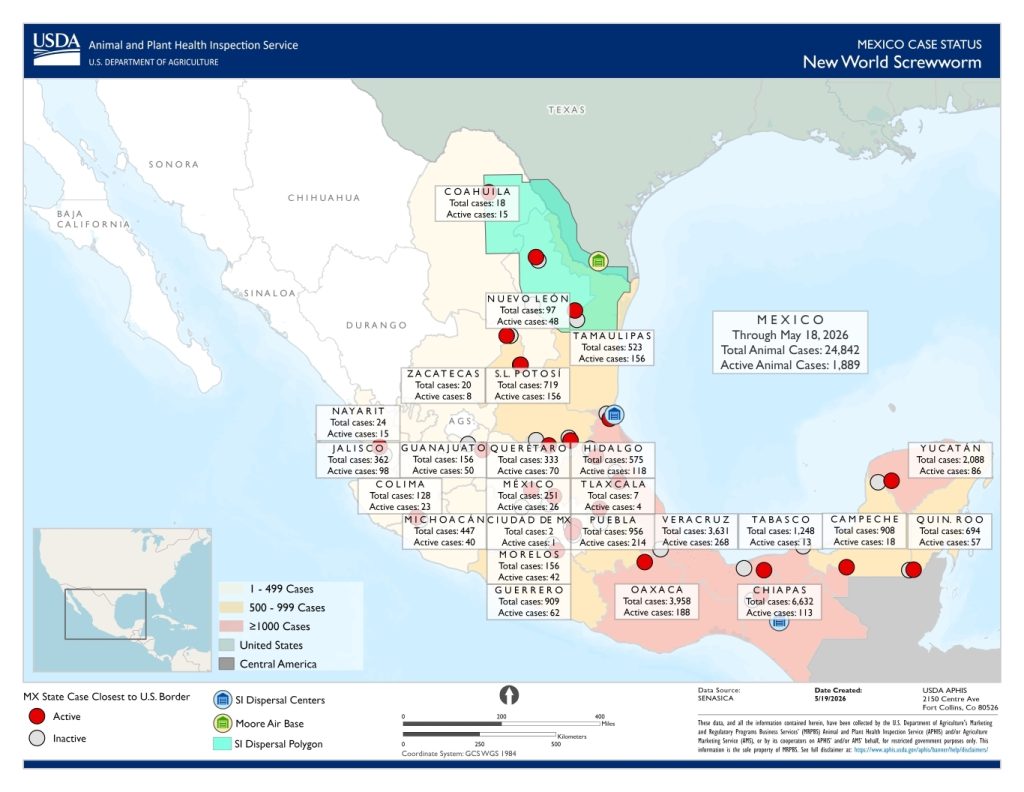
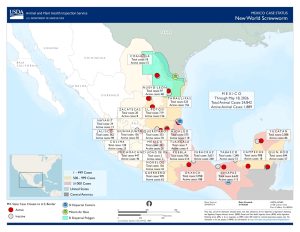
All of the United States’ southern ports of entry remain closed to livestock imports due to the presenece of the New World screwworm in Mexico. The USDA closed livestock trade —affecting bison, cattle, and horses—as of July 9, 2025. While most cases of NWS remain in the southern areas of Mexico, multiple infestations in cattle as well in other mammal species have been reported within 100 miles of the border in the past 10 days. USDA reported 156 active cases of NWS in Tamaulipas, 15 active cases of NWS in Coahuila and 48 active cases of NWS in Nuevo Leon on May 19, 2026. According to the American Veterinary Medical Association, a case of NWS in a four day old calf was reported within 60 miles of the U.S./Mexico border in April.
USDA continues to state that “Isolated detections outside of the known affected areas in Mexico are not unexpected, and the fact that they have been identified and addressed quickly show that our collaborative efforts with Mexico to implement the NWS Action Plan are working.”
USDA is involved in the dispersal of 100 million sterile insects per week in Mexico and “closely evaluates the location and circumstances of each new case to adjust sterile insect release efforts and locations as needed. Changes to the sterile insect dispersal area, or polygon, in Southern Mexico occur as needed to maintain broad suppression and help prevent the pest from moving further north toward the United States.”
On May 6, Texas Agriculture Commissioner Sid Miller issued a statement praising the U.S. Department of Agriculture’s Animal and Plant Health Inspection Service (USDA APHIS) for expanding New World screwworm sterile fly dispersal operations farther north along the Texas-Mexico border, calling it a critical step to protect Texas livestock, wildlife, pets, and the people who care for them.
The expanded dispersal zone now reaches as far north as Maverick County near Eagle Pass, strengthening the biological barrier against the deadly, flesh-eating parasite.
“USDA is making the right call by pushing sterile fly operations north. The New World screwworm threat is moving in that direction, and Texas isn’t waiting around.
“Let me be clear, this parasite is a nightmare. It attacks living animals, endangers wildlife, threatens pets, and could devastate our livestock industry if it gains a foothold in the United States. We eliminated it once, and we’re not letting it come back.
“Cases in Mexico are creeping closer to our border. Every mile matters. Expanding this zone builds a stronger biological wall across South Texas and takes the fight to the front lines before Texans pay the price.
“I’ve been sounding the alarm for months. Texas is ground zero, and we’re stepping up to defend our food supply, our economy, and our way of life.
“Ranchers, veterinarians, hunters, and pet owners, stay alert. Watch for unusual wounds, maggots, or abnormal fly activity and report it immediately. Early detection can stop an outbreak before it spreads.
“Texas agriculture feeds and clothes this country and we’re going to fight this threat with everything we’ve got,” Commissioner Miller said.
American Veterinary Medical Association
The American Veterinary Medical Association issued the following statement on the NWS on May 12, 2026.
Since the start of this year, two briefings on the looming NWS threat have convened on Capitol Hill. Both briefings, one by the House Modern Agriculture Caucus in January and another by the Senate Agriculture Committee in April, included the AVMA, livestock representatives, and NWS experts, who kept congressional staff members current on the situation south of the border.
Return of screwworm
The NWS fly (Cochliomyia hominivorax) feeds exclusively on the living flesh of warm-blooded animals, including humans. The maggots use sharp mouth hooks to burrow into the host’s flesh, causing painful trauma and potentially fatal infestations if left untreated.
The U.S. effectively eliminated NWS from within its borders in 1966 with the then novel sterile insect technique (SIT). Male flies are sterilized with radiation then released by the millions in areas where NWS is active. Because female NWS flies mate once before dying, they produce nonviable offspring after breeding with sterile male flies, resulting in the collapse of the NWS population.
The SIT effectively eradicated NWS out of North America and Central America all the way south to the Darien Gap, at the southern end of Panama. The Panama-United States Commission for the Eradication and Prevention of Screwworm (COPEG) has been producing sterile flies since the ’90s to maintain this barrier. But in 2023, health authorities noticed incursions of NWS north of the area where the SIT flies were distributed. Since then, NWS flies have been detected all the way up to Mexico, primarily associated with transportation of infested animals.
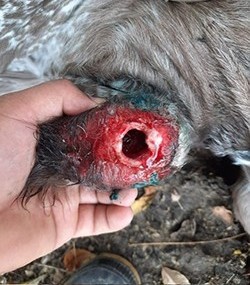
In November 2024, a confirmed NWS case in a cow in the southern Mexican state of Chiapas prompted the USDA to ramp up NWS mitigation measures along the U.S. southern border.
Last summer, the U.S. Secretary of Agriculture Brooke Rollins outlined a five-pronged eradication plan centered around animal-movement controls, surveillance systems and public outreach, SIT, and exploration of additional innovative strategies.
Construction was completed in February on a sterile fly dispersal facility at Moore Air Force Base in Edinburg, Texas. A sterile fly production facility is also being built on the base. The USDA held a groundbreaking ceremony on April 17, and anticipates the production center will be operational by November 2027, reaching production of 100 million sterile flies per week, with a goal of 300 million SIT flies per week in 2028.
Pets also at risk
Despite closing the U.S.-Mexico border to livestock movement and an accelerated sterile fly distribution program, former Arizona and Nevada state veterinarian Dr. Peter Mundschenk wonders whether the government’s limits on animal movement at the border are rigorous enough.
“One major concern for me is that pets from Mexico are still allowed to enter the United States with very limited oversight. The recent case of New World screwworm in a dog in Tamaulipas highlights that risk,” said Dr. Mundschenk, who recently served as president of the U.S. Animal Health Association.
“There is also concern,” he continued, “that some companion animal veterinarians in the U.S. may not consider screwworm in their diagnoses because it is often viewed as a livestock-only issue. In reality, New World screwworm can affect dogs, cats, and even humans, if eggs are laid in an open wound.”
“This is a serious issue for both livestock and companion animal veterinarians,” Dr. Mundschenk said.
Government authorities are urging livestock and pet owners in Texas, New Mexico, and Arizona to check animals daily for draining or enlarging wounds, discomfort, or larvae near body openings. Screwworm eggs are creamy and white, and infestations can be difficult to detect at first, according to APHIS.
Dr. Mundschenk encourages animal owners as well as veterinarians to err on the side of caution. “If you see something that doesn’t look right, say something,” he said. “Suspected cases should be reported immediately to wildlife services, state wildlife agencies, the state veterinarian, or public health officials, depending on the situation.
“One missed case could lead to major economic losses and an expensive response effort.”
Everyone’s problem
Jamie Jonker, PhD, chief science officer for the National Milk Producers Federation (NMPF), emphasized that NWS is not just a regional threat, but a national one. He explained how if the parasite were to breach U.S. biosecurity, routine livestock transportation would be a highly efficient method of spreading NWS far beyond the U.S.-Mexico border.
Dairy cows spend part of their lives in Texas, New Mexico, Arizona, and California, before being moved to other parts of the country. This national cattle pipeline, particularly the movement of first-lactation heifers, represents one of the greatest transmission vulnerabilities, Dr. Jonker said.
He said the NMPF is working with the U.S. dairy farming community to help them understand that NWS is a risk no matter where they are in the country.
“With the way that our dairy cattle and other livestock move, even the way wildlife move, there’s certainly the potential for the fly to be inadvertently carried into a very different geography, where you could have an infestation outbreak happen nine or 10 months out of the year,” Dr. Jonker said.
In September 2025, U.S. Animal Health Association (USAHA) partnered with the National Institute for Animal Agriculture to convene a day-and-a-half symposium on the topic of NWS. The event brought together experts, regulatory officials, animal industry leaders, and private industry stakeholders to discuss prevention, treatment, research gaps, animal movement, and continuity of business (COB) for animal agriculture.
Dr. Hallie Hasel, Wyoming state veterinarian, and Dr. T.R. Lansford, deputy executive director of the Texas Animal Health Commission, are chair and vice chair of USAHA’s Committee on Parasitic & Vector Borne Diseases. They helped lead the symposium and publish a white paper, “New World Screwworm (NWS) Preparedness, Prevention, and Response,” compiling conclusions from participants.
“Eradication remains the most appropriate goal and sterile insect technique remains the cornerstone strategy, based on the biology of the fly that females only mate once but will oviposit up to eight times while males mate multiple times. Sterile male mating results in infertile eggs that fail to hatch,” the paper’s conclusion states. “Current sterile fly production capacity is insufficient to respond to a widespread outbreak or sustain extensive buffer zones.”
The authors say complementary tools are essential, including effective preventive management practices, judicious use of systemic and local treatments, environmental controls, surveillance, and clear animal movement policies.
“Strategic investment in research, regulatory agility, interagency coordination and cooperation, with public–private partnerships are critical to mitigate risk, support continuity of agriculture and commerce, and protect animal and public health,” according to the paper.
USDA updates screwworm response playbook
On April 8, the U.S. Department of Agriculture (USDA) Animal and Plant Health Inspection Service (APHIS) introduced a revised “New World Screwworm (NWS) Response Playbook” that incorporates feedback from state animal health officials, veterinarians, and livestock industry stakeholders to ensure the plan is “field ready.”
Circulated this past October, the initial playbook draft was designed to support coordinated, science-based action in the event NWS is detected in the United States.
“While we are aggressively safeguarding American agriculture and working with Mexico to prevent further northward spread, we must also ensure that our domestic response plans are ready for immediate activation,” said Dudley Hoskins, USDA undersecretary for marketing and regulatory programs, in a statement.
APHIS made several key updates to the playbook based on the feedback it received, including clarifying and expanding:
-Terminology (e.g., NWS establishment, suspect, zones, types, phases, quarantines), treatment versus preventive NWS animal drugs and pesticide products
-Agency roles, responsibilities, and authorities
-Animal movement requirements
-Wildlife management
For example, the initial draft of the playbook did not distinguish non-livestock animals from other wildlife species. Feedback from government and wildlife officials highlighted that an all-encompassing wildlife protocol was operationally impossible given the varying regulations for wild deer, zoo animals, and commercial-raised elk. This feedback was incorporated in the updated version by establishing three distinct protocol categories: farmed wildlife, confined wildlife, and free-ranging wildlife.
Also, the agency updated four supplemental guidance documents that were posted with the draft playbook and added eight additional supplemental guidance documents, all referenced in the playbook. APHIS says it will continue to revise the playbook as preparedness activities advance.
As part of the ongoing effort to prevent New World screwworm (NWS) from re-emerging in the United States, the Food and Drug Administration in April issued emergency use authorizations (EUAs) for two additional animal drugs to treat and prevent NWS infestations in livestock, captive animals, and birds. Under an EUA, unapproved products or unapproved uses of approved products can be used to treat or prevent diseases in an emergency as declared by the Secretary of Health and Human Services.
Visit the AVMA to learn more about the flesh-eating screwworm and the threat it poses to animal health. More information can also be found at screwworm.gov.