Screwworm: USDA Grand Challenge funding, SWASS, TAHC Certified Inspector program
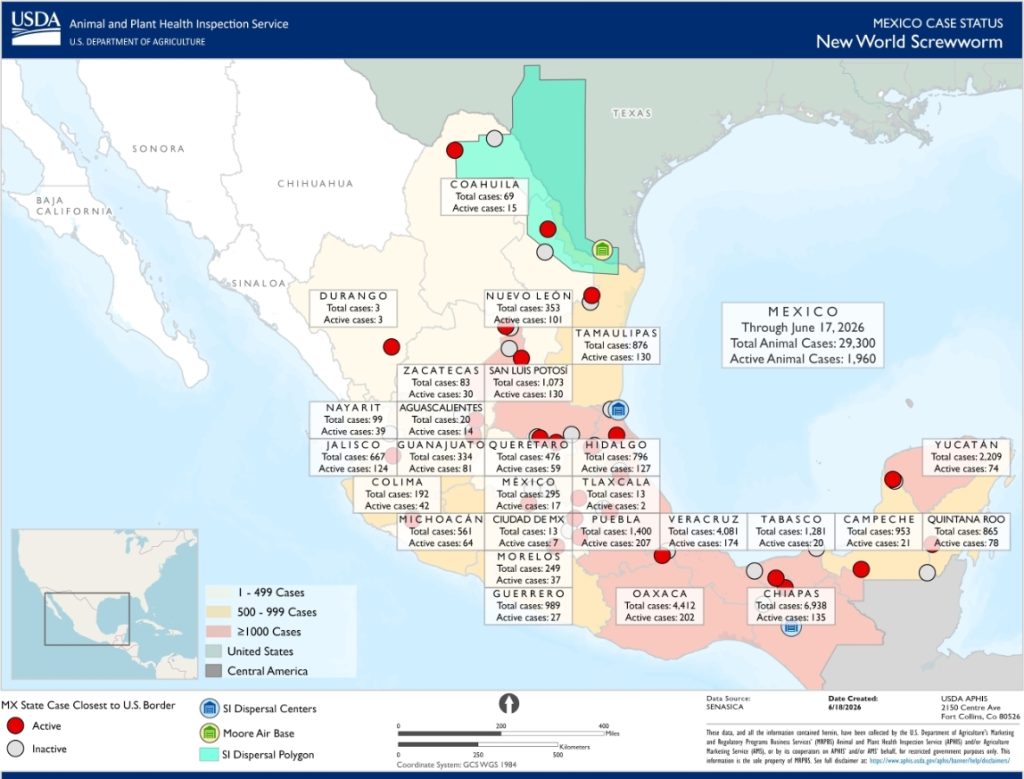
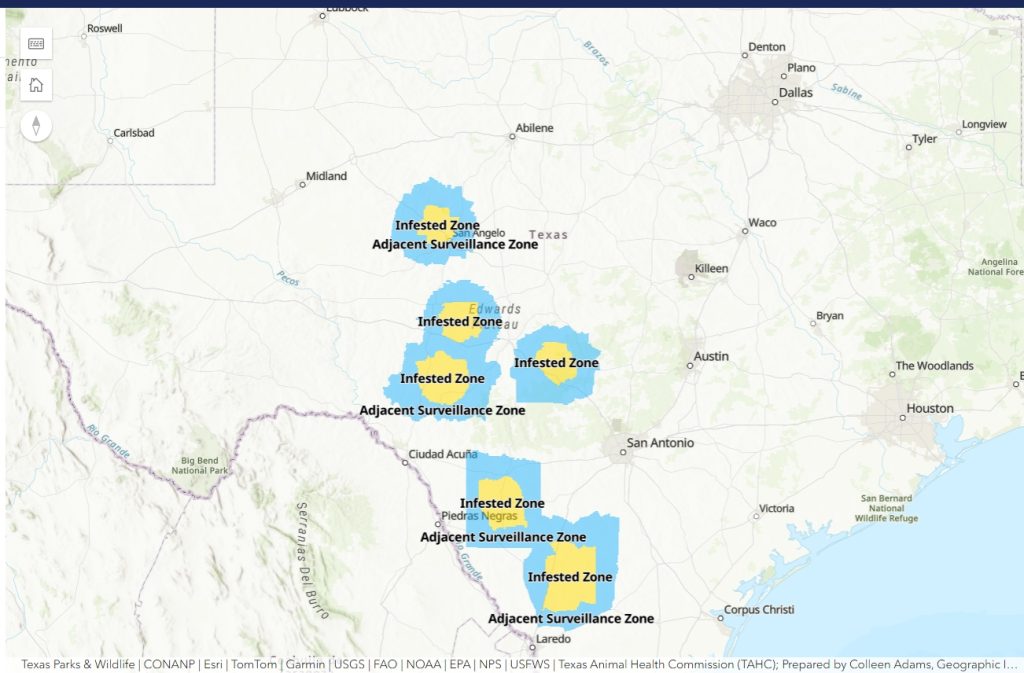
New World Screwworm was confirmed to be present in the United States earlier this month. Since the first case was confirmed on June 3, 12 total cases of NWS have been reported in U.S. livestock, with the most recent case reported on June 12. Mexico has reported 29,300 cases of NWS infestations since November of 2024, and currently reports 1,960 active cases, of which over 50 are located within 100 miles of the U.S. border.
According to USDA, “Active cases are those that involve ongoing disease mitigation efforts, including treatment and wound management of the infested animal until all wounds have healed.
“Inactive animal cases refer to situations where mitigation activities are no longer required. Either the animal has fully recovered—with wounds healed and treatment completed—or, in cases where treatment was not performed, appropriate measures have been taken to prevent the spread of NWS, such as appropriate carcass management of a deceased infested animal.”
Mexico’s National Service of Health, Food Safety, and Quality -SENASICA- defines a case as “active at the time of diagnosis. After 15 days, the case is revisited and becomes inactive if personnel verify absence of new wounds or larvae.”
Mexico suspends live animal exchange with U.S. over screwworm
Given the confirmation of cases of cattle screwworm in several counties of the state of Texas and New Mexico, on June 9, SENASICA, in coordination with APHIS and USDA, announced a temporary suspension of the importation into Mexico of live animals from the U.S.
According to SENASICA, this action is intended to protect the cattle herd in the northwest area of Mexico, where the screwworm is currently not present, specifically in the states of Baja California, Baja California Sur, Chihuahua, Sinaloa and Sonora.
“Authorities in both countries maintain a permanent exchange of information, as well as working meetings in which it was agreed to temporarily suspend the Animal Health Requirements Sheets for the importation into national territory of cattle destined for reproduction and slaughter; wild ruminants; horses for reproduction, work, sport, exhibition, transit and slaughter; pigs for breeding; sheep and goats for reproduction and slaughter, as well as songbirds, ornamental birds and birds of prey for marketing, as well as ferrets for companionship and marketing,” stated a SENASICA press release.
“With regard to companion dogs, APHIS and Senasica agreed to strengthen sanitary inspections at points of entry to Mexico and evaluate complementary measures to prove the health status of pets, provisions that will also be applicable to pet songbirds.
“The health authorities of Mexico and the United States maintain permanent coordination and continue with the technical and scientific exchange of information, in order to identify goods that do not represent a health risk and establish the measures and conditions that allow, in due course, the orderly and safe resumption of bilateral trade,” stated the release.
Texas Ag Commissioner urges USDA to deploy SWASS
According to a press release, Texas Agriculture Commissioner Sid Miller on June 8 demanded further action from federal officials, calling for USDA to immediately deploy the Screwworm Adult Suppression System, a proven USDA-developed program that uses targeted bait to kill fertile adult screwworm flies before they can reproduce.
“For over a year, I’ve been pushing USDA to bring SWASS back into the fight,” Miller said. “I’ve personally placed the research and bait formula in Secretary Rollins’ hands three separate times because we know this tool works. SWASS helped eradicate screwworm from the United States once before, and it can help stop this outbreak before it reaches even deeper into Texas.”
In a press release, Miller stressed that sterile fly releases remain critical but argued that sterile flies and SWASS are most effective when used together.
“It is important to note that neither I nor the Texas Department of Agriculture have advocated for the use of Dichlorvos in SWASS. While that insecticide worked well to eradicate the New World Screwworm from Texas in the 1970s, it has since been determined to be a carcinogen. Nevertheless, there are alternative insecticides available for SWASS which have been determined can be used to safely combat the screwworm as part as SWASS strategy. The cost of prevention is measured in millions. The cost of an outbreak in Texas would be measured in billions. The science is settled. The tools are available. What’s missing is urgency from the USDA,” Miller added.
Miller concluded, “You don’t win this battle with one tool, you kill fertile flies with SWASS while overwhelming the remaining population with sterile flies. That’s how we built the biological barrier that protected American agriculture for decades. That’s the strategy we should be using today.”
USDA, the Texas Animal Health Commission, and their state and federal partners have launched extensive surveillance, trapping, testing, and epidemiological investigations in response to the recent detections. Miller praised those efforts but cautioned that time is not on America’s side.
“Every new detection is a warning,” Miller said. “We have a narrow window to stop this pest before it gains a stronger foothold in the United States. Washington needs to move faster, deploy every proven tool available, and put SWASS back where it belongs—on the front lines of this fight.”
Commissioner Miller reiterated his call on the Trump Administration to immediately:
• Authorize and fund a comprehensive SWASS deployment program across Texas, the U.S.-Mexico border region, and other high-risk areas.
• Establish a joint U.S.-Mexico task force to coordinate aerial and ground suppression efforts on both sides of the border.
• Rapidly scale up SWASS pellet production and distribution using modern formulations and existing manufacturing capacity.
• Expand surveillance, trapping, inspections, and rapid-response teams to ensure every suspected case is detected and treated immediately.
• Continue aggressive expansion of sterile fly production facilities while simultaneously deploying SWASS as a bridge strategy rather than waiting years for new facilities to come online.
• Declare New World Screwworm a national agricultural emergency and marshal every available federal resource toward eradication.
Texas producers and pet owners are encouraged to immediately report suspicious wounds or signs of screwworm infestation to their veterinarian, the Texas Animal Health Commission, USDA officials, or the Texas Department of Agriculture at 800-TELL-TDA.
Funding for NWS Grand Challenge
On June 16, 2026, The U.S. Department of Agriculture announced funding for 40 breakthrough projects to bolster the nation’s defenses against New World screwworm. These innovative proposals, which will receive a combined total of about $105 million, promise to sharpen detection, accelerate control and eradication tools, and strengthen rapid-response capabilities.
USDA launched the NWS Grand Challenge on January 21, 2026, marking the next milestone for Secretary Rollins’ five-pronged plan to support producers’ success, protect the nation’s food supply, and build long-term resilience against NWS. The Grand Challenge called on innovators from federal and non-federal entities to help in the efforts to prevent the spread of NWS by developing high-impact projects to enhance detection, control, and eradication readiness.
“We launched the Grand Challenge expecting bold, innovative, and science-backed ideas to fight New World screwworm, and the proposals delivered just that,” said U.S. Secretary of Agriculture Brooke Rollins. “These projects represent the creativity, scientific rigor, and determination we need to reinforce our existing efforts, empower our producers, and safeguard American agriculture and our food supply. We have beaten this pest before, and by leveraging innovative solutions and advancements in technology we will beat it again in record time.”
USDA reviewed 226 applications, requesting about $664 million in total funding. Projects were selected based on their innovative approaches, scientific gold standards, and their potential to make a significant impact on the prevention and response to NWS.
In addition to the 40 projects announced today, work has already started on two additional USDA-funded projects that are a part of the Grand Challenge. Texas A&M AgriLife Research is assessing the feasibility, efficacy, and operational readiness of electron beam (eBeam) technology as a non-radioactive alternative to cobalt-60 gamma irradiation for sterilizing NWS pupae in sterile insect technique programs, and the University of Florida is evaluating two U.S.-made X-ray irradiators for sterilizing NWS pupae using secondary screwworm as a surrogate.
The Grand Challenge focuses on four core priorities:
-Enhance sterile NWS fly production to improve program efficiency and capacity.
-Develop novel NWS traps and lures to modernize detection and early warning systems.
-Advance NWS therapeutics and treatments to reduce animal health impacts and strengthen response capability.
-Develop tools that bolster preparedness and response, including repellents, ecological modeling, wildlife surveillance, or other innovative approaches.
Using a rigorous, competitive review process, a team of USDA, state, and industry experts evaluated the merits of the proposals and how well they supported the core priorities. USDA will work closely with these awardees to develop work and financial plans that ensure these projects meet these important priorities and protect critical taxpayer resources.
NWS is a serious pest that affects livestock, pets, wildlife, and, less commonly, people and birds. USDA’s ongoing efforts to fight NWS include sterile fly production, surveillance, and cross-border collaboration. The Grand Challenge complements these efforts by fast-tracking next-generation technologies and research that strengthen U.S. preparedness and response capabilities.
TAHC New World Screwworm Certified Inspector Program
Texas Animal Health Commission and Texas A&M AgriLife have worked together to develop a New World Screwworm Certified Inspector Program, which is available to individuals who are willing and qualified to serve as NWS Certified Inspectors.
Requirements for Current Authorized Veterinarians
If you are actively enrolled in the Texas Authorized Personnel Program, you already meet all eligibility requirements for NWS Certified Inspector status. To issue NWS Treatment/Movement Certificates, current TAPP veterinarians need to create an account on the NWS Treatment/Movement web application using the email address on file with with the Texas Animal Health Commission. To request the login link, please email authorized_personnel@tahc.texas.gov.
Eligible applicants include:
Licensed Veterinarians
Veterinary Technicians
Texas A&M AgriLife Extension Agents and Extension Specialists
Texas A&M AgriLife Extension Disaster Assessment and Recovery (DAR) Agents
Texas Department of Agriculture Inspectors
Texas Department of State Health Services Meat Safety Inspectors
Texas Racing Commission Inspectors
Animal Control Officers or Livestock Deputies
Designated personnel from temporary livestock aggregation points (such as livestock markets, sale barns, auctions, buy stations, exhibitions, fairs, and competition events)
Emergency Management Personnel, including County emergency management personnel, Emergency Services District (ESD) personnel; Texas Division of Emergency Management County liaison officers, district and regional staff; including current rostered volunteers
How to Apply
Complete the New World Screwworm Preparedness and Response Education course and pass the final exam with a score of 94% or higher.
Confirm that you meet one of the eligibility criteria above.
Download and complete the NWS Certified Inspector Application.
Email the completed application to: authorized_personnel@tahc.texas.gov.
Approved applicants will be added to the Texas Authorized Personnel Program, provided access to the NWS Treatment/Movement web application, and can begin issuing NWS Treatment/Movement Certificates.
New World Screwworm Information
For the most up to date information about NWS in the United States visit screwworm.gov.